Investing at the Intersection
The Broadening of Secondary Market Liquidity in 2025
May 22, 2026 6 Minute Read Time

Introduction & 2025’s key findings
Author
Global Research Director, Senior Economist – Insights & Intelligence

Author
Managing Director, Real Estate Partners Strategy

Global real estate secondaries volume reached US$25.1 billion in 2025, up 3% from 2024. The execution strategy continues to evolve, particularly through the continued dominance of GP‑led liquidity solutions and expanding breadth across sectors. Secondaries are a broader, more institutional liquidity mechanism and a parallel transaction system for private commercial real estate.
2025’s key findings
Building on our proprietary market-sizing framework—expanded definitions, proprietary deal logs, and AI‑enabled capture, we estimate that secondary transaction volume exceeded $25bn in 2025. The more consequential headline is the secondaries channel kept widening—more structures, more repeatable processes, and more deliberate portfolio management. Real estate secondaries are maturing, as a means of recapitalizing the ownership stack while leaving the underlying real estate, often the operator too intact.
Three trends stand out in the 2025 data.
- GP‑led structures remained the market’s organizing principle, while LP‑led liquidity grew by 15% year-over-year, a substantial engine of broadening liquidity.
- The sector concentration reflects where investors saw conviction amid uneven price discovery: industrial took the lead, the living sectors broadened, and retail participated selectively.
- Large-scale liquidity structures have gone mainstream. From mega continuation vehicles to entity-level partial stake sales, institutions are increasingly transacting at platform scale.
The anatomy of liquidity
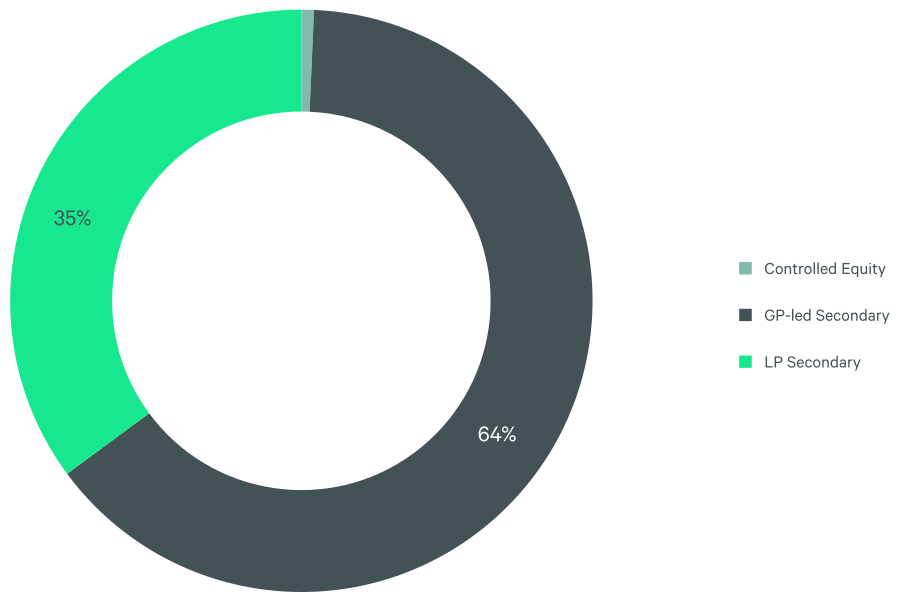
In 2025, GP-led secondaries accounted for US$16.1bn (64%) of total estimated volume — reflecting how sponsors have come to use continuation vehicles and recapitalizations not merely to bridge liquidity gaps, but as strategic instruments for preserving ownership, resetting business plans, and attracting expansion capital.
LP-led secondaries totaled US$8.8bn (35%) in 2025, up 15% from 2024 — a meaningful acceleration that reflects how LPs are increasingly turning to the secondary market not out of distress, but as a deliberate portfolio management tool. Rebalancing overweight positions, managing redemption queues, and accelerating capital recycling have all become routine drivers of LP-led activity, pointing to a market that is maturing on both sides of the transaction. Investors are able to access high-quality assets at discounted entry points, with attractive risk-adjusted return potential, reinforcing secondaries as a dynamic and efficient market for institutional capital.
As GP-led and LP-led structures grow more sophisticated and accessible, the market is broadening through choice rather than necessity — a hallmark of a truly institutionalized secondary market.
Figure 1: 2025 Secondary Transactions by Type
Industrial leads and living sector broadens; retail participates selectively
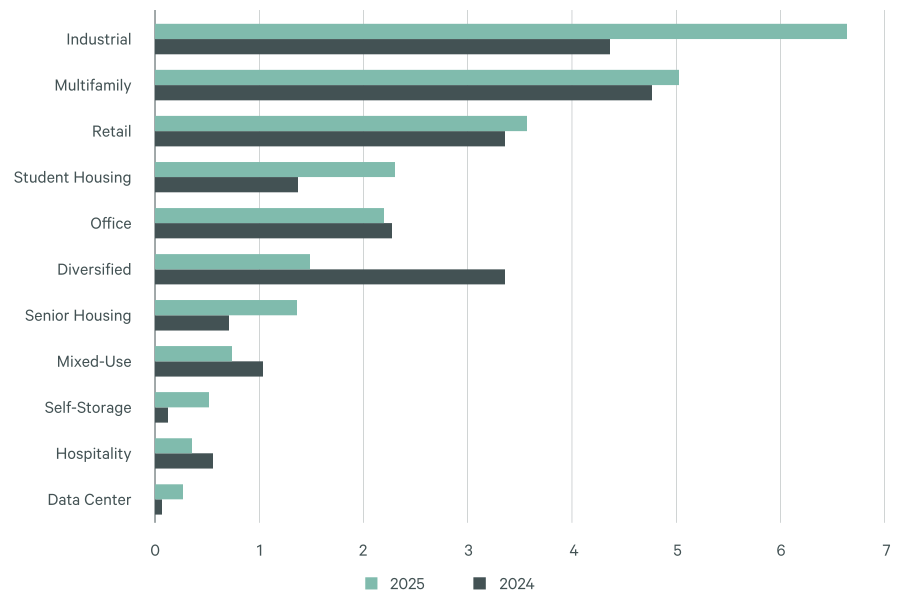
Industrial transactions grew 52% to US$6.7bn in 2025, sitting at the top of the leaderboard. Sustained institutional demand, driven by supply-chain reconfiguration, reshoring, and e-commerce growth, continues to attract the world's largest capital pools. Multiple transactions in 2025 showcase that sovereign and pension investors are actively adding exposure at platform scale.
Multifamily followed at US$5.0bn, reflecting continued investor preference for income-oriented residential assets amid persistent affordability pressures and resilient rental demand. Other living sectors — student housing (US$2.3bn) and senior housing (US$1.4bn) grew by 67% and 92% respectively in secondary transaction volumes, underscoring deepening confidence in demographics-driven, operationally intensive assets.
Retail featured meaningfully at US$3.6bn, concentrated in luxury, prime urban, and experience-oriented formats. Investors are selectively returning, but only where scarcity value and pricing discipline are clearly present. By selling partial stakes, sellers retain control over valuable assets and access additional capital efficiently.
Figure 2: Top Sectors for Secondary Transactions (US$bn)
The U.S. remains the liquidity anchor and Europe remains active
The United States remains the global anchor for secondaries activity, with US$11.9bn traded in 2025, up 34% from 2024. It reflects the depth and liquidity of the U.S. private real estate capital markets, the prevalence of GP-led structures, and the sheer scale of institutional capital seeking active portfolio management solutions.
Continental Europe followed at US$7.2bn, up a steady 8% from 2024. Activity spanned major markets including Spain, France, Germany, and the Benelux region, with platform-level transactions in the living sector driving a meaningful share of volume.
Figure 3: Secondary Transactions by Geography (US$bn)
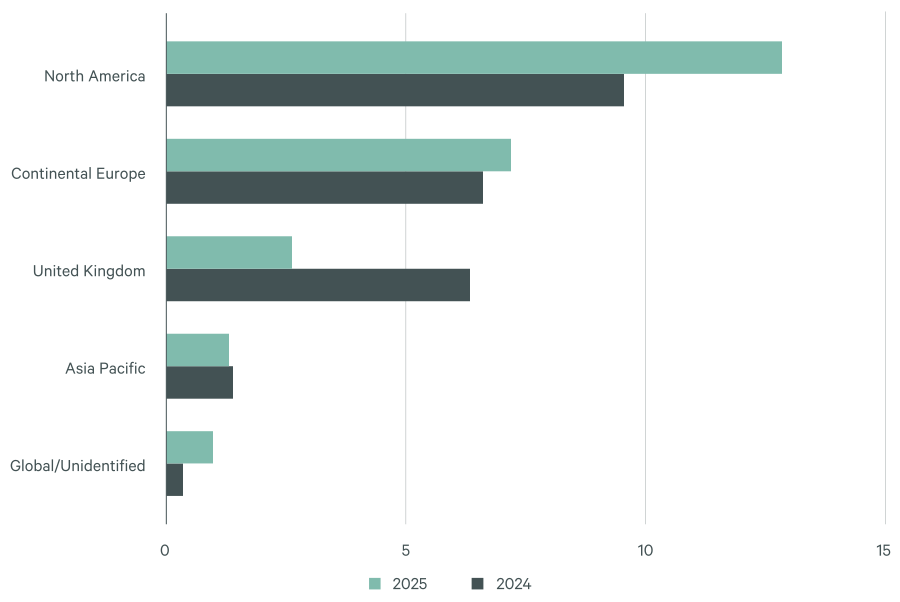
As more repricing went into the rearview mirror, secondary transactions pulled back in the United Kingdom, but the country remained the second largest market after the U.S. appetite remained healthy for trophy assets.
Together, the regional picture reinforces a familiar theme: liquidity flows where price discovery is clearest and institutional infrastructure is deepest.
Large-scale liquidity structures have gone mainstream
One of the defining features of 2025 was the scale and sophistication of individual transactions.
Partial stake sales reached new prominence in 2025, with several high-profile transactions illustrating how institutions are increasingly willing to transact directly in the equity of stabilized, trophy-quality assets. Buyers gain direct exposure to high-quality assets without bidding for full control, while sellers crystallize value and recycle capital without exiting the ownership structure entirely. The result is a more liquid market for assets that were once considered effectively untradeable at the margin.
Mega continuation vehicles told a parallel story. GP-led structures are no longer confined to resolving end-of-fund liquidity constraints. NAV-based pricing has become the anchor mechanism for these transactions, providing a shared valuation reference that aligns buyer and seller expectations, supports pricing discipline, and allows deals to close with greater efficiency than in prior cycles.
These structures signal a market that has grown comfortable transacting at size. What was once considered bespoke is now repeatable — and that repeatability is itself a sign of maturity.
Conclusion
As primary market liquidity remains uneven and exit timelines stay extended, the secondary market will continue to absorb that friction — not as a fallback, but as a deliberate and repeatable solution. The question for investors and sponsors is no longer whether secondaries belong in the toolkit. It is how to deploy them with greater precision, at scale, and across a wider range of situations.