Market Research
U.S. Student Housing: Why All News Is Local and What It Means Beyond the Headlines
May 5, 2026 5 Minute Read Time
Author
Director - Americas Insights & Intelligence

Early in my career, a mentor said, “there is no such thing as a national housing market.” He was pointing to the fallacy of composition: what is true for the whole is not always true for individual components, and vice versa.
U.S. higher education is undoubtedly at a crossroads: the number of high school (HS) graduates peaked last year and is projected to decline through the next 15 years. But all news is local. Many universities are positioned to buck the national trend and even benefit from a consolidation of students and resources. Housing markets around these universities will be under increased strain despite national enrollment declines.
Those who can sift through the idiosyncrasies, build mutual understanding with local stakeholders and execute at a high level still have the chance to drive win-win-win outcomes for investors, universities and communities alike.
Beyond the headline
The Western Interstate Commission for Higher Education (WICHE) anticipates that the number of new U.S. HS graduates peaked in 2025 and will decline through 2041.1 This decline traces back to births, which most recently peaked in 2007 (18 years prior to 2025, uncoincidentally) and declined during and after the GFC.2
Fortunately, demographics move slowly. The higher education sector has been aware of and planning around the looming demographic shift for nearly a decade.3 While recent federal policies and attitudes towards higher education layer additional challenges, many universities remain well-positioned to not only survive but thrive in the new enrollment landscape.
There are approximately 5,800 post-secondary institutions in the U.S., including nearly 2,700 four-year institutions.4 Universities on the fringes of the higher education sector will be on the front line of attrition; smaller regional universities, lesser-known private universities, for-profit universities and two-year institutions will likely (but not all!) fail at an elevated rate.
But four-year universities that recruit nationally and/or benefit from strong regional demand growth, led by major public flagships and elite private universities, especially those in the sunbelt, stand to benefit from the coming consolidation.
First, not all states will see declining applicant pools. WICHE projects Florida and Texas to lead absolute growth in graduating HS seniors from 2026 to 2041, followed by Tennessee, South Carolina, Idaho and North Carolina.
Enrollment trends at public university systems in these states already far surpass the national average. The University of North Carolina (UNC) system expanded enrollment at 15 of 16 campuses in 2025 and the University of Tennessee system set an enrollment record for the sixth consecutive year in 2025.5 Flagship universities like the University of Texas at Austin and University of Florida have leveraged record in-state demand to become highly selective. As of writing, complete numbers for Fall 2025 are unavailable but we expect that both achieved record enrollment with a 25% or less acceptance rate.6
The question is not whether these institutions will grow, but how they will manage that growth. There is a role for private capital to alleviate those growing pains in partnership with the key stakeholders that will determine the growth trajectory, including the university, the surrounding community, the university system, the state government and state and local taxpayers.
Meanwhile, managed growth at the top state flagships in the sunbelt has driven significant spillover demand to lower-tier in-state options and neighboring state flagships. The University of Arkansas, for example, set an enrollment record for the fourth consecutive year in 2025; nearly 30% of the student body hailed from Texas, up from less than 5% in 2004.7
Most of the projected declines in graduating HS seniors are concentrated in high cost of living and/or Midwest states, led by California, New York, Illinois, Pennsylvania, Michigan and Ohio. California alone accounts for more than one-quarter of the projected decline in the national HS pipeline (and has by far the most prestigious state university system top to bottom, though I may be biased as a California native and UCLA alumnus).
Universities will adapt. There is perhaps no better case than the University of Illinois (UI) system, which boasts the #36 ranked university nationally (#12 public university) in the 2026 U.S. News and World Report rankings at its flagship Urbana-Champaign campus.8
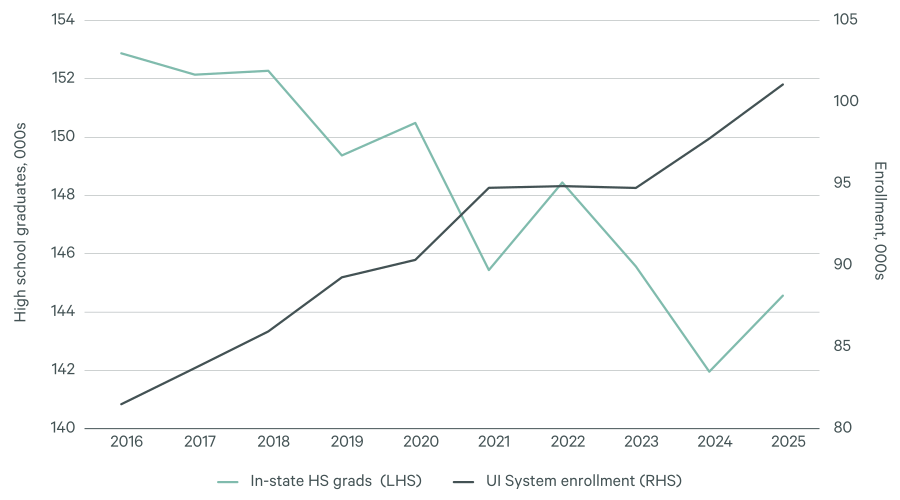
Despite a shrinking in-state HS pipeline for the last decade, the University of Illinois system surpassed 100k total students for the first time in Fall 2025 (Figure 1). The UI system attributed its success to streamlining the application and transfer process and growing international enrollment.9
Figure 1: Illinois annual high school graduates vs. University of Illinois System total enrollment
In the hardest hit states, declining HS graduation pipelines will present challenges to university systems that will likely need to prioritize campuses for future investment and growth. But again, the theme is consolidation, not extinction. These states boast some of the top universities in the world that recruit nationally and globally. Decreased in-state competition for acceptance at the top universities will be a boon for the residents that these universities were founded to serve, which hopefully will engender some goodwill from voters.
The opportunity
Leo Tolstoy’s Anna Karenina famously opens, “All happy families are alike; every unhappy family is unhappy in its own way.”
Many of the secondary and tertiary sunbelt markets that host major state flagships experienced a surge in pandemic-era in-migration that stressed local housing affordability for students and non-student residents alike. Those pressures are likely to sustain.
University enrollment and housing growth is often chicken and egg. Many universities enjoy strong collaborative relationships with their surrounding communities and others coexist uneasily, particularly when the university’s enrollment objectives directly confront community-wide housing affordability concerns.
There is an opportunity to work with local stakeholders at the most impacted universities and cities to drive positive outcomes for all parties by developing dedicated student housing (on-campus and off) and preserving attainable housing options for all residents (students and non-students). There will be a pressing need in secondary and tertiary sunbelt markets that stand to benefit from broader in-migration trends on top of enrollment consolidation, including among the largest growing demographic: seniors. Many flagship universities boast top regional medical campuses and retirees appreciate the proximity to best-in-class medical care alongside lower cost of living relative to larger cities and enhanced cultural amenities and vitality as compared with similarly sized cities that lack a university anchor.
For those willing to look, attractive risk-adjusted opportunities remain in a sector where a rising tide won’t lift all boats.
2 U.S. Centers for Disease Control and Prevention (CDC). Retrieved from Moody’s Analytics, January 20, 2026.
3 Nathan D. Grawe’s book “Demographics and the Demand for Higher Education,” published in 2018 and based on his 2017 award winning research, is often credited as the first seminal work in the space.
4 The Total Number of Higher Education Institutions Decreases by 2 Percent | IES
5 Which universities are shattering their fall enrollment records
6 UT Sets All-Time Highs for Enrollment and Student Performance - UT Austin News - The University of Texas at Austin; Freshman Profile Infographic For Download_2025-26
7 Enrollment by State | Office of Strategic Analytics & Insights | University of Arkansas
8 University of Illinois Urbana-Champaign - Profile, Rankings and Data | US News Best Colleges
9 U of I System sets fall enrollment record of more than 101,000 | U of I System