Market Research
U.K. Single-Family Housing: The Institutional Opportunity at a New Frontier
August 24, 2026 3 Minute Read Time

A structural shift in U.K. rental demand
Author
Director – Insights & Intelligence

U.K. single-family housing (SFH) is expected to deliver some of the highest annualized returns of any U.K. real estate sector over the next five years, outperforming peer residential markets in Continental Europe by 250 basis point (bps) on average.1 Despite growing investor interest, institutional ownership of the U.K. private rented sector stands at just 3%, representing an opportunity to build at scale in a market constrained by chronic undersupply, strong demographics tailwinds and a regulatory environment favoring professionally managed capital.
Demographics and affordability
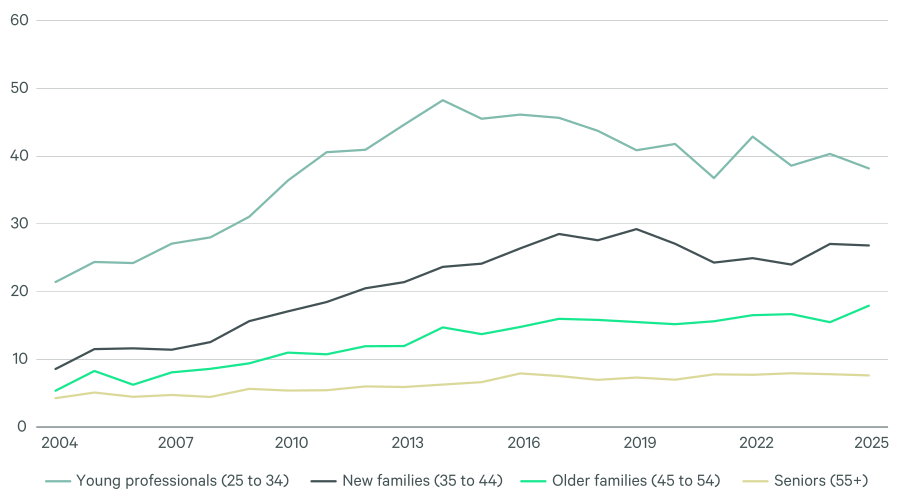
The U.K. rental market has undergone a fundamental structural shift over the past two decades. The average first-time buyer age has risen from 29 in the 1990s to 34 today,2 with house price-to-income ratios running at seven to eight times annual income, double the level seen in the 1990s. A generation of younger urban renters are now ageing into families, driving increasing demand for larger homes, outdoor space and access to schools. The proportion of the 35-44 age cohort renting privately has grown steadily over the last few decades, rising from 9% in 2004 to 27% in 2025 (Figure 1). At the same time, average tenancy lengths have risen from 3.7 years in 2011 to close to five years today,3 reflecting a structural shift in which renting is increasingly a long-term lifestyle choice rather than a transitional tenure.
Figure 1: Renter proportion by age group, %
The demand base for rentals is broadening beyond families. Senior homeowners, asset-rich but cash-constrained in retirement, represent a growing demand pool. Relocating to well-located suburban rental schemes with garden space and community amenity offers a practical and increasingly attractive alternative to costly later-living products.
Chronic undersupply
The U.K. housing shortage is persistent and well-documented. Successive governments have failed to meet house building targets for decades. CBRE IM estimates the shortfall now stands close to one million units. Available rental listings for houses stood 30% below the 2017-2019 average at the end of 2025,4 while average U.K. rents have grown 33% over the past five years, outpacing house price growth of 18%.5
CBRE IM forecasts rental growth of 4.1% per annum (p.a.) over the next five years,6 with the strongest performance expected in supply-constrained suburban submarkets where modern, high-quality stock is scarce. Suburban rents, typically up to 40% below equivalent city center benchmarks, provide an affordable entry point for tenants and a sustainable base from which to grow rents over the long-term.
Government policy support and the Renters' Rights Act
The U.K. government's housebuilding ambitions and planning reforms provide a supportive backdrop for institutional investment. The Mansion House Accord—a voluntary initiative for U.K. workplace pension providers to commit at least 10% of their funds in private markets by 2030, with at least 5% in the U.K.—signals policy intent to channel long-term pension capital into productive U.K. assets, of which housing is expected to be a major beneficiary. Adding to this, both Homes England (£39 billion) and the National Housing Bank (£16 billion) have committed public sector money to U.K. house building with the aim of courting greater private capital into the sector. With the U.K. government treating institutional capital as a long-term housing delivery partner, this should provide a significant and solid foundation for future growth in institutional ownership of U.K. residential.
The Renters' Rights Act, which came into effect in May 2026, introduced policy which forms an important next step in the U.K. rental market's professional evolution. No fault evictions have been abolished and fixed-term leases have been replaced with rolling periodic tenancies and annual reviews. Tenants have also been given a clearer route to challenge both excessive rental increases and poor housing conditions. This is accelerating the ongoing structural shift within the private rented sector, as growing numbers of smaller private landlords look to exit the market after a decade of steadily declining profit margins. Many of those homes have been absorbed into owner-occupation, adding to overall rental supply pressures.
The net result is an opportunity for institutional operators to take increasing market share of the private rental market. Even under the reformed regulatory framework, the U.K. remains one of the least regulated rental markets in Europe. Rents can still be increased in line with market norms, favoring long-term landlords looking for sustainable growth rather than short-term profits. Institutional SFH, with its longer average tenancies, lower tenant churn and professional management infrastructure, is structurally well-positioned to absorb the operational requirements of this new and more disciplined rental regime.
The SFH opportunity
A market at an inflection point
Sector allocations in U.K. real estate are changing rapidly, impacted by structural changes to the way we live, work and play. Our own internal analysis of the investable universe in 2040 suggests the overall residential sector could reflect close to 40% of this benchmark, up from around 24% today. For investors building multi-asset portfolios, SFH provides early-cycle access to this structural reallocation ahead of broader institutional adoption.
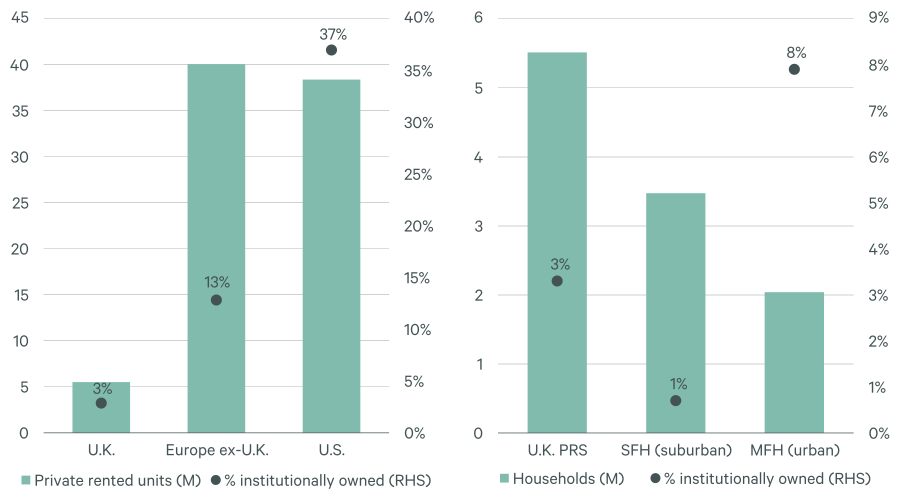
Nearly £9 billion has been invested in U.K. SFH since 2020 according to Savills, a real estate company based in London. In 2025 alone, £3.2 billion was deployed, representing 59% of total Build-to-Rent (BTR) investment and marking the first year in which SFH overtook multifamily housing by annual investment volume. Operational institutional stock has tripled in that time to more than 26,000 homes, with a further 19,000 already in the pipeline.7 Despite this momentum, institutional penetration remains at just 1% of the suburban private rented sector, compared with 8% for urban multifamily (Figure 2). This sits well below levels seen in both Europe (13%) and the U.S. (37%).8 CBRE IM estimates the sector could unlock £50 billion of investment over the next decade to meet rising suburban rental demand, a figure that would still represent a modest fraction of the 3.5 million households currently renting privately in suburban locations across the UK.
Figure 2: Institutional ownership of the private rented sector
House builder alignment and entry pricing
SFH is becoming embedded within house builder business models rather than treated as a short-term volume outlet. According to a recent 2026 report by Savills, all the U.K. house builders surveyed now consider sales to SFH investors when acquiring land, with 70% viewing forward sales to institutional investors as a long-term strategic alternative to private sales.9 With current discounts of 10%-15% to open market values, this provides a compelling partnership for volume house builders to exit tranches of their pipeline at scale, while offering SFH investors an attractive yield premium on cost. We expect these partnerships with both volume and SME house builders to deepen further, providing increasingly reliable access to development pipeline.
Investment characteristics
Return and yield profile
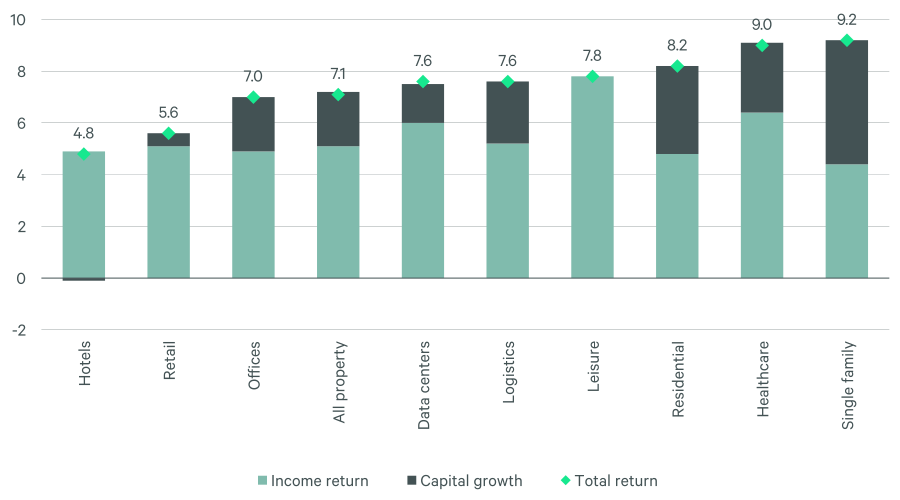
CBRE IM forecasts SFH to generate 9.2% total gross returns per annum over the next five years (reflecting a stabilized market beta portfolio excluding costs, fees and taxes), one of the highest projected returns within the U.K. real estate market. This compares with 8.2% for the broader residential sector and 7.1% for all property (Figure 3). The return profile reflects a balance of both income and capital growth, providing both a defensive income floor and exposure to structural rental value appreciation. While we believe there to be scope for yield compression over time, our view here remains conservative. Instead, long-term sustainable rental growth will do the heavy lifting over the coming cycle, supported by more affordable starting rents in the sector and a highly resilient occupier base.
Figure 3: Total gross return by U.K. real estate sector, Q2 2026-Q1 2031, % p.a.
The return forecasts and projections contained in this article are based on current assumptions and are hypothetical in nature. Actual results may differ materially. Performance will be affected by changes in interest rates, market conditions, occupier demand and regulatory requirements. Real estate is inherently illiquid and there is no guarantee that assets can be realized at the expected timing or price.
SFH net initial yields now sit at approximately 4.25%—a level marginally above their long run average—having moved out 100 basis points since their peak in 2021. Development yields have also trended out toward 5.0% providing a healthy margin over stabilized product for largely derisked forward funding opportunities. This combination of income yield, development premium and rental growth potential provides a compelling entry point into the sector.
Operational efficiency
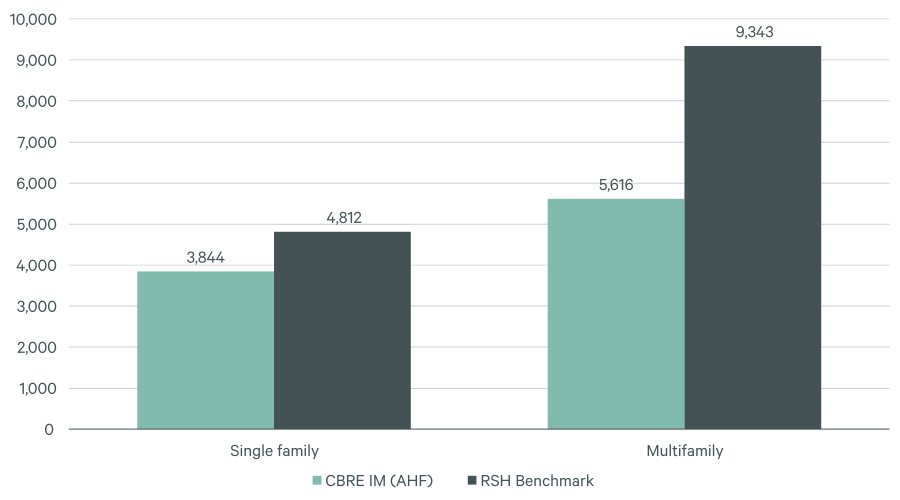
SFH offers a structurally lower operational cost than multifamily. Gross-to-net income leakage runs at 15%-20% for SFH versus 35%-40% for multifamily,10 driven by lower staffing requirements, limited communal amenity and reduced building infrastructure required by regulation. Additionally, families settled within a school catchment area show materially lower mobility, reducing voids and reletting costs and producing more predictable long-term income streams. This operational advantage is evident in per-unit cost data, with the U.K. RSH Benchmark showing a roughly 50% difference in costs between the two tenures (Figure 4).
Figure 4: Operational cost per unit p.a., GBP, SFH vs. multifamily
Reduced regulatory burden and improved development structure
SFH schemes carry materially lower exposure to the Building Safety Act and Gateway process—a mandatory planning and building safety check requirement for residential towers over 18 meters or seven stories—when compared to the urban multifamily sector. This typically has reduced construction delays and building cost uncertainty, with fewer planning constraints to overcome before the first spades can be put in the ground. Additionally, the phased delivery structure of SFH developments spreads construction, delivery and lease-up risk across several tranches of units rather than concentrating it all in one single block handover upon completion. These characteristics help to reduce the j-curve impact on performance, while producing a much more defensive income profile that holds up well across different points in the economic cycle. For investors already active in residential, this approach offers genuine portfolio diversification in terms of risk-return dynamics.
Exit and liquidity
Exit liquidity is improving markedly. Investment volumes have increased year-over-year (Y-o-Y) since 2020 and CBRE IM estimates could reach at least £5 billion a year over the coming decade.11 Alongside long-term policy changes which should attract additional domestic capital into the sector (as discussed above), the investor base is becoming increasingly diverse. The U.K. living sector more broadly has grown to become the second largest residential investment market in Europe, behind only Germany, with U.K. and European pension funds, U.S. private equity and Asia Pacific capital all active over the past five years. As one of the fastest growing subsectors within this, U.K. SFH is expected to offer an increasingly deep and sophisticated investor pool. This should generate significant liquidity over the coming decade, allowing early movers to exit larger stabilized portfolios at scale.
Conclusion
U.K. single-family housing offers institutional investors attractive risk-adjusted returns, first-mover advantages and exposure to one of the fastest-growing sectors in U.K. real estate. Institutional ownership remains a fraction of comparable international markets, yet a supportive regulatory environment—including new rent regulation introduced in 2026—increasingly favors scaled operators with long-term capital. Forecast total returns are among the highest in U.K. real estate, driven by sustainable rental growth rather than yield compression, with a lower operating cost base than urban multifamily, and a smoother return profile through phased site delivery. These factors combined place U.K. SFH as one of our strongest conviction calls in Europe.
2 Skipton Group's Annual Home Affordability Index, March 2026.
3 ONS English Housing Survey, 2025.
4 Zoopla Rental Market Report, June 2026.
5 ONS/Nationwide to Q2 2026.
6 CBRE IM forecast as at H1 2026.
7 Savills UK Single Family Housing Report, March 2026.
8 Green Street, ONS, Savills, BPF estimates 2025.
9 Savills UK Single Family Housing Report, March 2026.
10 CBRE IM estimates as at H1 2026 using MSCI, RSH and internal assumptions.
11 CBRE IM estimate as at H1 2026 based on growth of the PRS market, institutionalisation rate and housing need.