Market Research
The U.S. Net Lease Advantage
November 3, 2026 10 Minute Read Time

Introduction
Author
Americas Head of Research

Author
Senior Director – Americas Research

The term “net lease” denotes a distinctive lease structure under which the tenant assumes responsibility for operating expenses and capital expenditures that would otherwise fall to the landlord in a gross lease structure: property taxes, building insurance and all operating expenses including upkeep. The result is a simplified ownership model that essentially converts a real estate asset into something resembling a long-duration bond, with contractually-obligated cash flows and minimal management burden and risk for the investor, while creating maximum flexibility for the tenant.
The origins of net leasing trace to the early 20th century, when landlords sought more predictable income streams by shifting variable operating costs and cap ex to tenants. National retail chains seeking to expand while maintaining operational control over their stores embraced these long-term net lease commitments, including pharmacies, grocery operators and quick-service restaurant franchises.
For investors, net lease real estate offers higher yields and stable long-term cash flows undiluted by rising operating expenses or regular cap ex. As a result, net lease REITs have delivered higher average returns with lower volatility and currently feature the highest cap rates among major REIT categories.
For tenants, net lease structures create conditions akin to outright ownership: a long-term commitment to the asset, freedom around build-out and branding and, for existing owners, the opportunity to unlock capital through a sale-leaseback transaction with a real estate investor.
Net lease investments span all commercial sectors, ranging from massive data centers, corporate headquarters and large-footprint logistics to corner lot retail locations, small-scale manufacturing plants and local offices. Thus, the term “net lease” describes an investment strategy rather than a specific sector or type of real estate. The large majority of net lease investments, however, are sub-$10 million and more than half, by count, are retail—though industrial constitutes a larger total square footage.
Defining net lease real estate
The net lease sector in theory includes all commercial real estate leased under a triple-net structure, ranging from hyperscale data centers to corporate headquarters to logistics facilities to retail branches. In practice, however, the term “net lease” tends to denote smaller, free-standing properties, the majority of which are retail assets and include as tenants major pharmacies, banks and quick-service restaurants, among other national and regional chains, as well as an abundance of local small and medium-sized enterprises, or “SMEs.” Industrial represents the largest portion of net lease real estate by square footage and includes many prior owners who have entered into net lease arrangements through sale-leaseback transactions with investors. The net lease strategy can also include smaller single-tenant office properties. The small and medium-sized firms occupying many net lease properties typically are not “credit tenants” in the traditional sense but also do not command the pricing power of a national chain and are often tied to their location.
Given the small size and low price points typical of most net lease assets, institutional investors will typically build or buy a portfolio of net lease properties, creating diversification across regions, markets, tenants and sectors. Net lease portfolios often include sizeable allocations to secondary and tertiary markets offering higher yields for similar credit risk.
Why invest in net lease real estate?
At first glance, net lease real estate may not be an obvious candidate for institutional ownership. Net lease investments typically feature price points under $10 million, are often located in secondary markets and locations and house a wide range of tenants, many with lower or no formal credit rating.
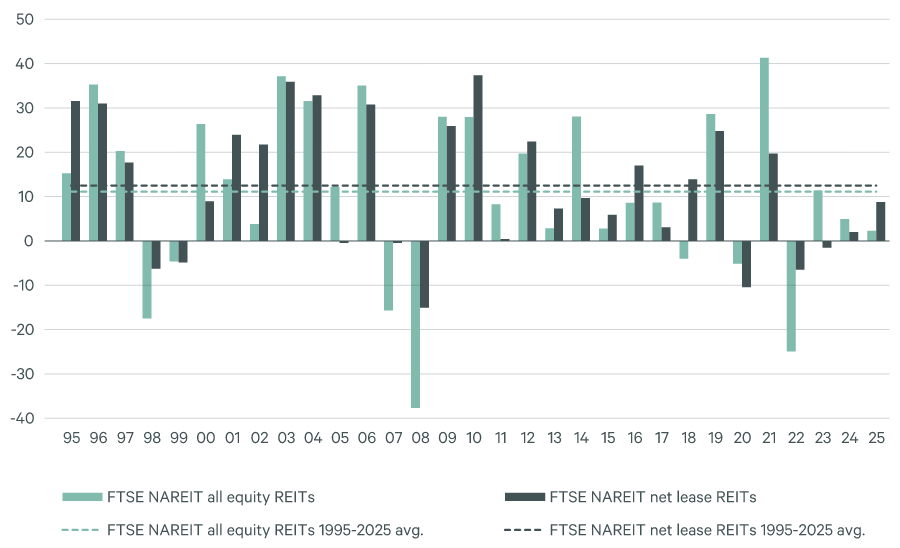
Nonetheless, institutionally-owned net lease real estate has delivered an enviable track record of outperformance over the past 30 years. As shown in Figure 1, net lease REITs have delivered an average annual return of 12.5% from 1995 to 2025, 140 basis points (bps) above the all-equity REIT average of 11.1%, per FTSE-NAREIT data. The higher returns have also come with lower volatility, resulting in a Sharpe ratio of 0.83 for net lease compared with 0.58 for equity REITs on average.
Figure 1: FTSE NAREIT annual total returns: all equity REITs vs. net lease REITs 1995-2025, %
For illustrative purposes only. Current market conditions differ from prior market conditions, including during prior periods of stress and dislocation. There can be no assurance any prior trends will continue.
Several factors have supported the outperformance of net lease real estate:
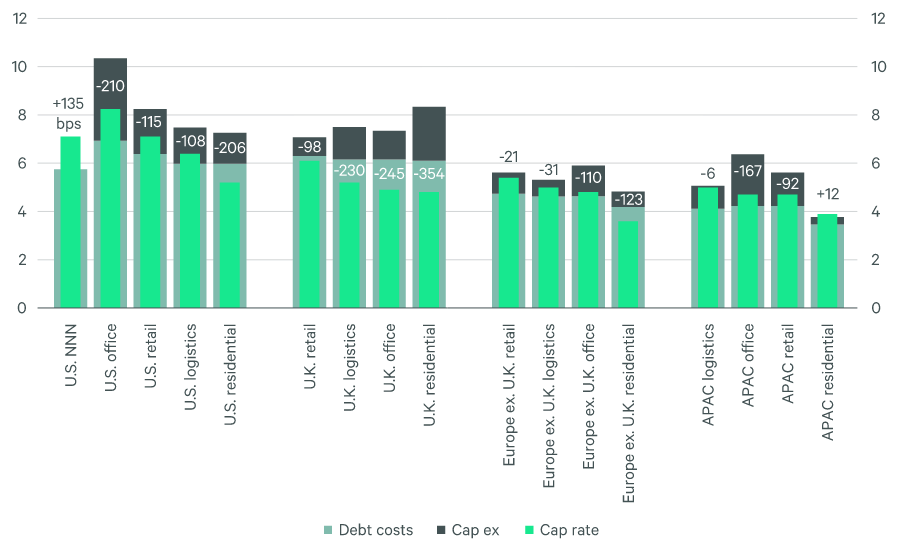
Higher yields: Net lease REITs have delivered a 100-bp income return premium over the All Equity REIT index since 1995—an advantage that remains largely intact today, with U.S. net lease real estate priced at an implied 7.1% cap rate on average (Green Street as of Q3 2026). The higher yield comes from greater exposure to secondary markets and non-credit tenants.
Minimal cap ex: On average, capital expenditures consume more than 25% of net operating income generated by U.S. commercial real estate, per NCREIF data from Q1 2022-Q2 2026. In a net lease, however, tenants are obligated to cover most capital expenditures, reducing the burden on landlords to nearly zero.
Downside resilience: From 1995-2025, in years when the All Equity REIT index has delivered negative returns, those returns have averaged -16%. In those same years, net lease REITs produced average returns of -4%. Net lease REITs delivered their worst performance in 2009 with a -13% returns, while equity REITs overall delivered a -38% return. The higher income returns and natural diversification of net lease real estate underpin the strategy’s stability.
The combination of higher going-in yields and minimal cap ex overhead positions net lease as the only sector globally likely to deliver a positive yield spread on average, as shown in Figure 2.
Figure 2: Net lease only sector likely to deliver a positive yield spread, %
Diversification is another key benefit of owning net lease real estate and likely contributes to the strategy’s downside resilience. The small footprints and low price points of net lease real estate require institutions to own a large number of net lease assets to create scale and naturally create well-diversified portfolios across regions, markets and industries that ameliorate the risk of the lower credit quality of many SME net lease tenants.
A net lease portfolio ideally will feature higher renewal rates and long-term tenancy, given that net-leased assets are often critical infrastructure for the tenants, especially net lease assets acquired through sale leaseback transactions. For example, a dental practice that has operated from the same location for decades, patiently building up a multi-generational demographic catchment of clients and generating stable revenues well in excess of its rent obligations presents a fundamentally different credit profile from a tech start-up or restaurant concept without an operating track record, even though neither of these examples carries an investment-grade rating.
An expanded market: Adding a net lease strategy expands the investible universe for institutions by adding sub-scale investments of less than $10 million—the price points that make up the vast majority of transactions, if not of transaction value. The low price points unlock access to smaller markets and secondary locations otherwise off-limits to institutional investors—but which offer higher yields and may host nationally/globally important production facilities and necessity retail. Finally, through net lease structures institutions can acquire older and lower-quality assets without regard to the higher maintenance and upkeep costs, which are offloaded to the tenant.
The size of the U.S. net lease opportunity
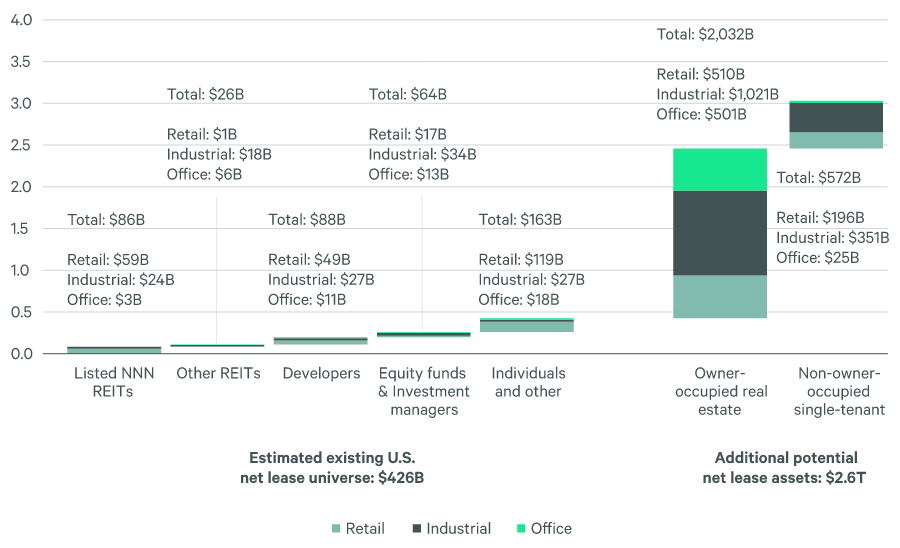
We estimate the current market cap of net lease real estate in the United States at $400-$450 billion. We base this estimate on our analysis of CoStar data, starting with real estate owned by the seven net lease REITs identified by Green Street totaling an estimated $86 billion. We then identify another $350 billion of value in properties that have transacted in NNN investment sales per CoStar. This estimate of the U.S. net lease market includes about $250 billion of retail real estate, $130 billion of industrial real estate and $50 billion of office real estate. Institutions control about 60% of the total—but non-institutional owners make up the single largest ownership bloc, controlling more than $160 billion of net lease real estate, of which an estimated $120 billion is in retail properties. The abundance of smaller owners presents an opportunity for institutions seeking to assemble net lease portfolios.
An even greater opportunity to grow the net lease sector lies in owner-occupied properties. We estimate that owner-users control more than $2 trillion of real estate value that could be converted to net lease through sale-leasebacks, including more than $1 trillion in retail value owned by tenants.
CBRE Investment Management Research estimates the total potential value of net lease real estate in the United States at around $3 trillion, or about 20%-25% of all U.S. commercial real estate. Single-tenant properties of less than 100,000 SF not currently under NNN structures offer another $570 billion in potential net lease value were a new owner to convert the lease to NNN (Figure 3).
Figure 3: Estimated size of U.S. triple net real estate market, $ trillions
Risk considerations
Net lease investing offers unique advantages but also comes with risks specific to this segment of the market. The single-tenant concentration remains the most significant structural exposure: a net lease property is either fully occupied or fully vacant, with rarely any partial occupancy to cushion income loss from a departing tenant. Thus, diversification across tenants, sectors and geographies is essential to any net lease portfolio.
Re-leasing at the end of a primary lease term poses risks as well. Many net lease properties are purpose-built or heavily customized for a specific operator's use. A former drive-through pharmacy or dedicated childcare facility may require significant capital expenditure to use by an alternative tenant, eroding the passive income advantage that made the asset attractive. Investors acquiring net lease assets late in their lease cycle must price this re-leasing cost into their underwriting or accept that residual asset value at expiry is materially uncertain. Owners can mitigate the re-leasing risk by maintaining a long weighted average lease term (WALT) through active asset and portfolio management.
While net lease structures fully protect landlords from expense inflation, landlords also typically see less income growth from net lease assets as a result of lower rent escalations and less frequent renewals. Per Green Street, same-store NOI growth for net lease REITs has averaged near zero over the past decade.
Market liquidity also presents potential risks, as the pool of potential buyers may be limited in smaller markets. On the other hand, the low price points for most net lease properties broadens the pool of potential buyers to include local individuals and smaller family offices.
Conclusion
Triple net lease real estate occupies an important and useful position in the investment landscape, combining the income certainty and credit-analytical framework of fixed-income markets with the inflation protection and tangible asset ownership of commercial real estate. This hybrid character makes it an adaptable allocation across a wide range of portfolio objectives, from liability-matching income for pension capital to tax-deferred wealth accumulation for private investors. Low price points make it accessible to a wide range of investors, and it exists across every market, large and small, and hosts tenants from every industry.
Adding a net lease allocation to an institutional portfolio will likely boost income returns and lower volatility given net lease real estate’s record of high and stable total returns, underpinned by high income returns which closely approximate the rental streams. Net lease also brings diversification into smaller assets in secondary markets and locations, as well as exposure to SME tenants. We believe these tenants, assessed through disciplined credit underwriting rather than reliance on agency ratings, deliver materially superior income yields, better lease economics, and exposure to structurally resilient local service operators who occupy an increasingly important segment of the private economy. Net lease structures can provide valuable capital to these firms through sale leaseback transactions while creating a value real estate asset for the investor.