Market Research
The Case For and Against Narrow Cap Rate Spreads
December 8, 2025 5 Minute

Author
Global Research Director, Senior Economist – Insights & Intelligence

The U.S. cap rate spread (real estate cap rates minus 10-year Treasury yields) currently stands at 172 basis points (bps) as of Q3 2025, placing it in the 24th percentile historically since 1965 (Figure 1). This represents a major compression from the average spread of 342 bps between 1991 and 2019, raising critical questions about how long current spreads can persist. Real estate investors endured negative spreads reaching as low as -268 bps during the 1980s Great Inflation Period, demonstrating that narrow or even negative spreads are possible under certain conditions.
Will today's narrow spreads persist due to a greater need for inflation protection and other structural shifts, or will they revert to historical norms should market fundamentals deteriorate? This analysis examines both sides of the argument, weighing the forces supporting continued compression against the gravitational pull of mean reversion.
Figure 1: Cap rate spread

Learning from the 1980s
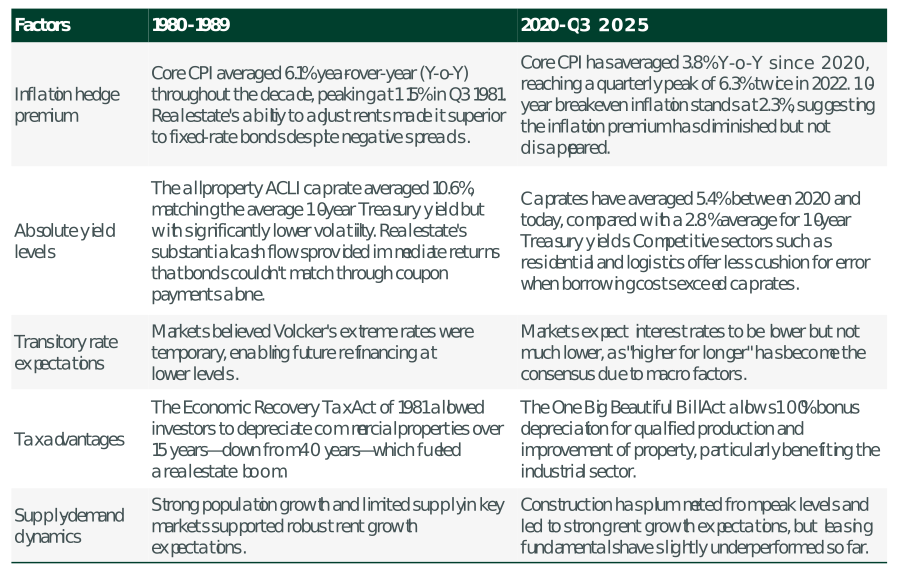
The 1980s negative spreads period offers crucial insights. From 1980-1985, spreads were negative 70% of the time, reaching a nadir of -268 bps in Q2 1984. Why did investors accept this?
Figure 2: The perfect storm of factors
The case for sustained narrow spreads (less than 200 bps)
The experience of persistent negative spreads to 10-year Treasury yields in the 1980s shows that cap rates can remain low relative to reference interest rates for a sustained period, and investors may continue to tolerate narrow spreads. Real estate may be viewed as attractively priced, after a roughly 20% value correction1 and currently trading at the bottom of return percentiles, while equities are trading at the top percentiles driven by richly priced tech stocks. Cap rates of 5.5% also outpace investment-grade bonds when real yields are scarce.
Real estate offers built‑in inflation protection through lease rent escalations, rising replacement costs and persistent labor-driven rent pressure. Commercial leases often include 2%-3% annual increases, if not higher.
A sharp collapse in new construction is setting the stage for supply shortages and potentially outsized rent growth over the next three to five years. Since 2022, logistics starts are down 65% by square footage and multifamily starts have fallen 44% by units. Office starts have dropped 60% since 2019, while retail construction has been minimal for over a decade, with per‑capita space back to 2004 levels.2
Capital market conditions continue to improve. In the U.S., transaction volume increased 15% Y-o-Y in the first three quarters of 2025 led by neighborhood shopping centers and a rebound in modern offices.
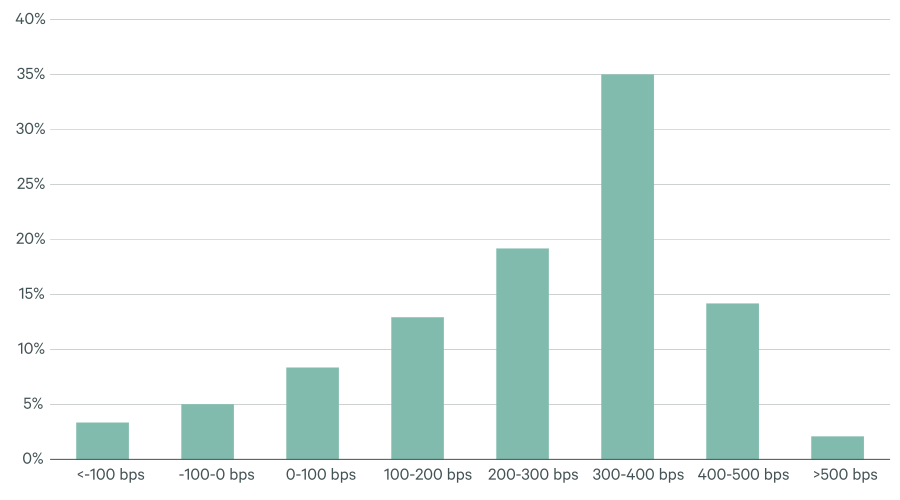
Figure 3: Cap rate spread distribution from 1965 to Q3 2025, %
The case for spread normalization (more than 200 bps)
Since 1965, cap rate spreads have exceeded 200 bps 70% of the time (Figure 3), indicating a strong historical tendency toward spread normalization. Relatively low cap rate levels and “higher for longer” interest rate expectations suggest low operational margins of error.
Deteriorating fundamentals are likely to drive cap rates upward. In residential and logistics sectors, the lingering effects of peak supply growth have weakened net absorption and rent growth. The office sector continues to grapple with a surplus of vacant space and ongoing capital needs amid a flight to quality. Retail faces uncertainties from chain store bankruptcies and delayed tariff impacts.
The Economic Recovery Tax Act of 1981 benefited all commercial real estate sectors by accelerating depreciation for entire buildings and associated assets. It fueled asset value growth, which was a key factor in investors’ tolerance of narrow and even negative spreads to 10-year Treasury yields. That factor seems lacking today. Though the Big Beautiful Bill Act encourages targeted investment in industrial and renovated properties, it lacks the broader and immediate cash flow benefits to drive a real estate boom.
High inflation combined with slow economic growth is the worst conundrum for central banks. Bloomberg’s economist survey reports a 35% recession probability, even as the “sticky” measures of inflation remain above 3%. A recession will likely lower interest rates but also expand risk spreads, keeping borrowing costs high. Investors who would rather wait until a recession for lower interest rates may instead face difficult loan issuances and renewals amid deteriorating space market conditions.
Conclusion: Asymmetric risk requires defensive positioning
The asymmetry of risk is clear—limited upside from further compression versus significant downside from mean reversion. With cap rate spreads in the 24th percentile historically, the prudent strategy is preparing for widening while remaining tactical enough to capitalize on any near-term strength.
The path forward requires emphasizing fundamentals and income growth while strategically allocating to emerging sectors. Today's commercial real estate landscape spans a wide range of strategies, property types and markets, enabling sophisticated investors to build resilient portfolios that deliver consistent returns independent of cap rate spread dynamics.
2 Data from Costar and CBRE Investment Management as of Q3 2025.