Investment Perspectives
Reviewing Listed Real Estate: Top Questions From Investors
September 3, 2025 8 Minute Read Time

Prefer a PDF?
As markets have progressed in 2025, we’ve received several questions from investors on listed real estate. In our latest update, we review:
- The setup for listed real estate: fundamentals compared to broad equities and private markets
- Our preferences: global vs. U.S. real estate, and the view across sectors and regions
Listed real estate: fundamentals compared to broad equities and private markets
Over the long-term, listed real estate has led broad equities, bonds and private real estate. A compelling portion of total return has been driven by growing income that offers the opportunity for inflation protection.
25-year performance comparison: Listed Real Estate had led over the long-term

Compared to broad equities more recently, however, listed real estate has underperformed; for the trailing 5 years, as an example, global real estate has underperformed global equities by ~9% on an annualized basis. As a result, relative valuations compared to broad equities are discounted by more than one standard deviation below the long-term average. We believe listed REITs are deserving of a multiple more in line with broad equities, and that the underlying stability of real estate cash flows is underappreciated.
Relative 12-month forward P/E multiples (Global Real Estate vs. MSCI World)

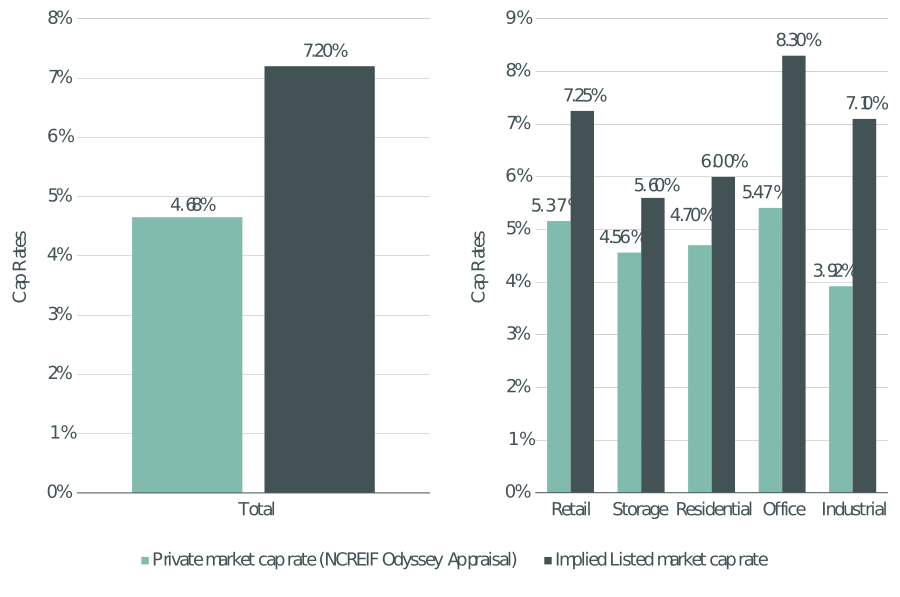
Compared to private markets, valuations in listed real estate are also compelling. While listed real estate has outperformed private, listed assets in the U.S. are trading at a 7.2% implied cap rate as of Q2, compared to private markets appraised at a ~4.7% cap rate. Comparisons are imperfect, given the sector differences between private and listed (a higher percentage of next generation assets in listed, including healthcare, technology, net lease and others) as well as the lagged nature of private market valuations. We believe that private markets are in the process of recovery and offer total return potential. We further believe that the combination of both listed and private real estate offers the opportunity for strong blended risk-adjusted returns, balanced liquidity and a complementary combination of assets across sectors.
Listed market valuations compared to appraised private market values
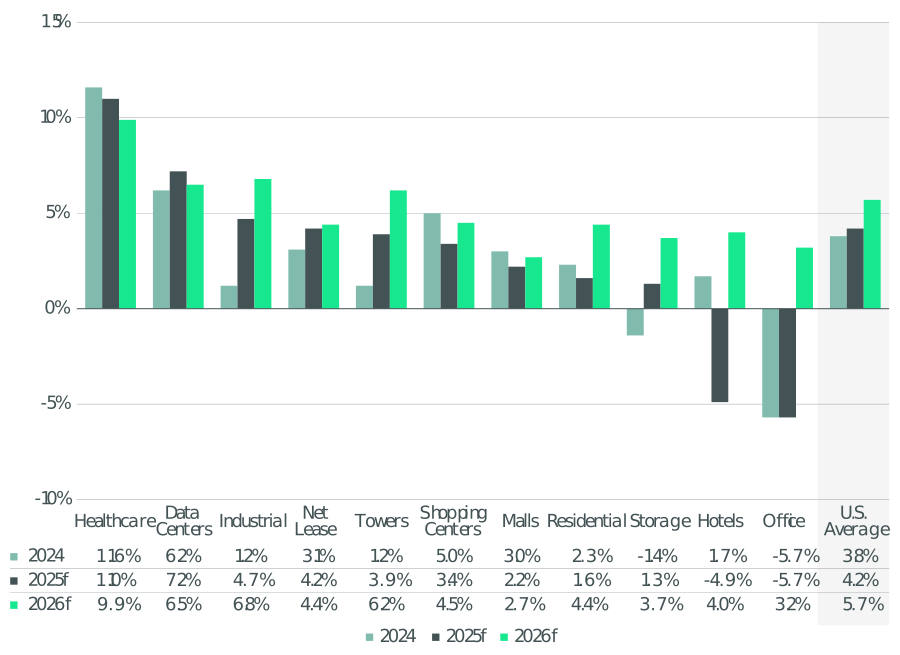
Across listed real estate sectors, we see growth potentially accelerating in 2026 to ~5%. Non-U.S. regions have the potential to accelerate more, with strong growth seen in Australia, Canada and Japan. By sector, dispersion emerges to a greater degree. Private pay senior housing continues to capitalize on powerful demographics and takes advantage of premium valuations to acquire on an accretive basis. Given end-user demand, data centers are likely to maintain strong growth, even with the need to reinvest in their assets. In logistics, growth is improving as new supply is being absorbed. At the lower end of the spectrum, select malls can maintain consistent levels of growth; office returns to positive territory in 2026 and self-storage fundamentals gradually recover in 2026 from a 2025 low. The general health in supply/demand, potential stable to moderating debt costs and the select potential for acquisitions is expected to contribute to sustained growth.
U.S. real estate earnings growth forecast by sector
Our preferences: global vs. U.S. real estate; our positioning
As 2025 has progressed, investors have begun to reappreciate global (vs. U.S. only) exposures. While our strategies take the largest active weights at the security level, followed by the sector and regional levels, we have maintained a tilt toward global exposures for the last year. Today, we still see an opportunity for investing in global real estate over the next five years. We acknowledge U.S. underperformance in H1 2025 and the potential in the U.S. for central bank cuts.
Why do we maintain a preference for global? As shown below, we see global growth accelerating at a greater rate (compared to its long-term average) compared to the U.S. Global real estate further trades at a greater relative discount, compared to its own history, versus the U.S. When we aggregate our unlevered IRR analysis across regions, we see a ~13% annualized total return opportunity in global real estate over the next five years, which is ~100 basis points better than U.S. real estate alone.
Global growth is accelerating at a greater rate compared to the U.S.

Our views on sectors; our positioning
Our sector and security ranking is a dynamic process; each week and month, we formally rank global real estate regions, sectors and securities across a multi-factor model with the goal of maintaining balance and eliminating unintended biases. Our positioning reflects the views of our investment staff, which leverages the broader CBRE IM organization and our library of proprietary listed real estate metrics spanning back over four decades. As we consider the markets today, notable positioning at the sector level includes a bias towards the following:
CBRE IM Global Listed Real Estate positioning, July 2025 By U.S. sector


An unappreciated opportunity in listed real estate
As we look ahead, we see listed real estate with an advantaged opportunity compared to broad equities and private markets driven by attractive valuations, enabled by
resilient earnings and enhanced by conservatively set dividend income. As we consider a dynamic and changing environment, global real estate and the ability of active managers to enhance returns also present opportunities. We look forward to continued listed real estate performance as 2025 closes and 2026 begins.