Investment Perspectives
Regime Change: The Outlook for Listed Infrastructure
Is listed infrastructure at an inflection point for investors?
December 12, 2024 10 Minute Read Time

Prefer a PDF?
After a solid year in 2024, listed infrastructure is positioned to continue to perform for investors. We believe we are at an inflection point with a series of dramatic regime changes: from a U.S. Democratic to a Republican administration; from a cycle of global central bank hiking to one of gradual easing; from a first-mover generative AI boom to that of broader beneficiaries; from stronger-than-expected economic growth to one of moderation. When we review our outlook, we find that listed infrastructure is:
- Gaining with secular growth independent of U.S. politics and poised to benefit from a Republican government
- Suited to an environment of moderating economic growth
- Compelling to investors from a potential total return perspective
- Conducive to positioning for active management
Considering secular growth and U.S. administrations
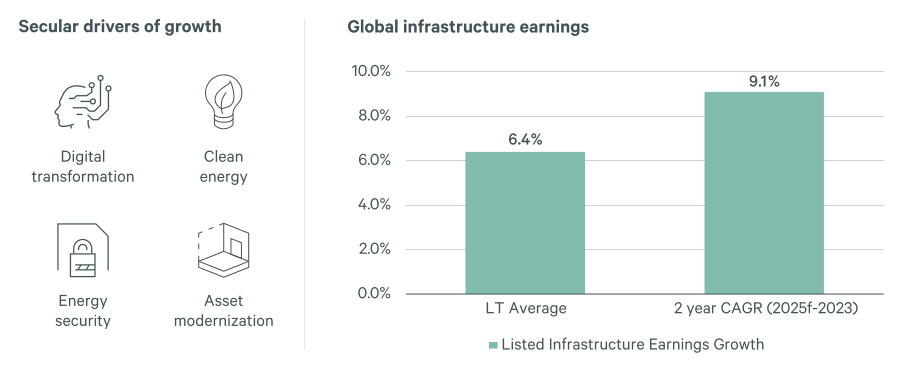
Historically, listed infrastructure has been politically agnostic. Cash flow per share has outgrown broad equities and inflation independent of the political party in power. Today, generative AI is proving a notable accelerant for infrastructure. We’re seeing rising levels of demand across data centers, power generation and large-scale utility and midstream networks, which are seeing enhanced opportunities for investment. While demand is broad-based, we believe an unappreciated story exists in global utilities beyond just the United States. Globally, we are seeing estimates for future electric grid network spend ramping up. As we wrote about recently, we see this contributing to earnings growth above historical averages. In our portfolios, we have dramatically enhanced exposure to global network spend beneficiaries.
Not only is infrastructure an “all of the above” solution for global accelerating energy needs, but it is also a potential beneficiary of U.S. tariffs and rising levels of domestic manufacturing. Near-shoring remains constructive for Americas freight rail, which could further benefit from a moderate decline in corporate tax rates. Globally, in an environment of persistent inflation, transport assets such as toll roads are prized; they have recently contributed to infrastructure’s strong revenue growth and should endure in an environment in which inflation remains persistent. All-in, when we consider the major sectors within the infrastructure asset class, we expect that intermediate-term infrastructure earnings growth will exceed the long-term average—independent of which party controls the U.S. government.
Aided by secular drivers, infrastructure growth is accelerating
The recent U.S. election has been in sharp focus in our conversations. Contrary to some expectations, we see infrastructure as poised to benefit in a Republican administration. We summarize our views below:
Infrastructure outlook remains positive with President Trump’s re-election
Pro-growth policies
- Historically, President Trump has been pro-growth and pro-infrastructure.
- Reduced regulation at the agency level could enhance development of major projects (both electric and hydrocarbon networks).
- A fall in corporate tax rates or rise in U.S. manufacturing activity could be a tailwind for freight rail infrastructure.
An “all of the above” solution
- Energy policy is likely to continue as an “all of the above” strategy: more gas/oil, more renewables, and more nuclear are required to meet unprecedented levels of demand.
- The 2016 election proved a buying opportunity for renewables, which are cost competitive and continue to gain share in the U.S. electric generation fleet.
Inflation Reduction Act
- The IRA has benefitted Republican-controlled/leaning States and is seeing current support in the party—85% of IRA investment and 68% of related jobs are in Republican states.
- Oil & gas companies are in favor, having invested in low-carbon energy projects benefitting from the IRA. Nuclear tax credits (included in the IRA) have support from both Democrats and Republicans.
- Areas at risk currently are Chinese battery parts/imports. Large infrastructure companies have historically managed their procurement chains well.
Considering economic moderation and infrastructure performance
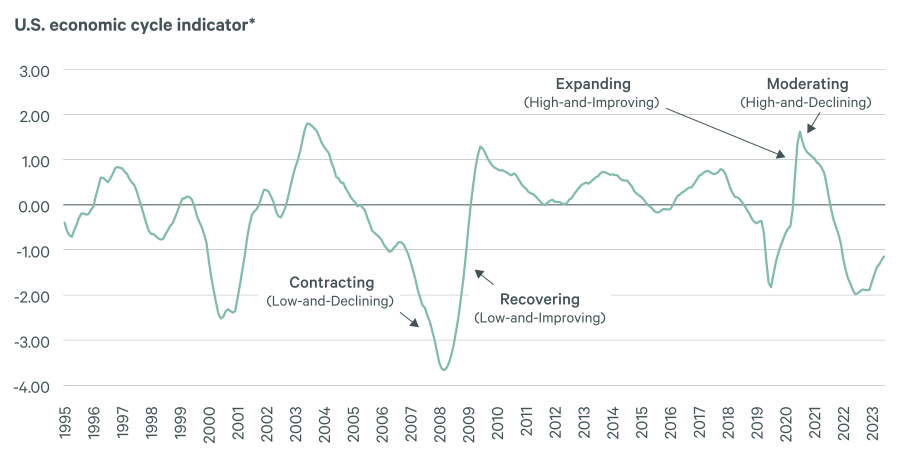
In an environment of moderating economic growth, infrastructure can be further prized by investors. The asset class is currently embarking on a bull run of accelerating secular growth while broader economic growth is moderating. Historically, periods of moderating economic growth have been positive for infrastructure and led to outperformance of broad equities by approximately 700bps during those periods.
Listed infrastructure performance during periods of moderating economic growth

The outlook for total returns
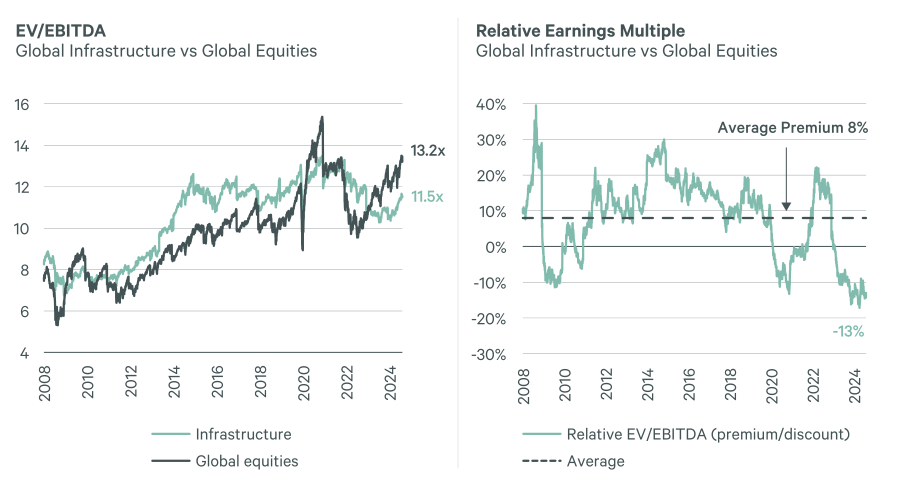
We believe the opportunity for infrastructure outperformance is greater today given the starting point for investors. As of Q4 2024, listed infrastructure is discounted relative to broad equities and to private valuations. As investor focus rotates from the first movers of generative AI to that of broader beneficiaries, and they seek assets with accelerating growth, we expect infrastructure to re-rate. When coupled with infrastructure’s approximately 3%-4% dividend yield and the prospects for active management, we expect potential infrastructure returns to eclipse the 8%-10% levels seen over the past two decades. So far in 2024, this has been the case with the asset class delivering approximately 16% through November 30, 2024.
The starting point for investors: discounted valuations
Leading to the building blocks of above-average total returns

Positioning for performance
We continue to optimize our portfolios to build on our long-term track record. Today, over 60% of our portfolios capture the themes of increasing power demand, grid investment and data center growth. We see accelerating fundamentals that are resilient; decarbonization efforts that continue to be influenced by state and local policies as well as competitive economics, while the broader U.S. generation fleet requires an “all of the above” energy solution from infrastructure. As discussed earlier, global grid investment continues to be a focus; with expectations for enhanced investment and the need for climate resilient and reliable assets that we believe are well positioned.
Our global transportation holdings continue to provide strong inflation capture, while in the Americas, freight rails are seeing a volume recovery that will benefit from U.S. manufacturing strength or moderate corporate tax cuts. Communications assets such as data centers continue to see pricing power while also participating in the demand for new hyperscale activity. We are less positive near term on cell-towers due to their demonstrated rate sensitivity and more elongated earnings recovery.
From a regional perspective, we continue to see value in developed market infrastructure where earnings are accelerating. After a strong run, emerging markets have recently begun to falter in 2H24. We see unfavorable relative valuations and growth, while weaker currencies, tariff/trade concerns and historical issues of regulatory and governance quality affirm our conviction for developed market exposures in the future.
The road ahead for infrastructure
As we look ahead, we see 2025 as a year capping a series of dramatic regime changes: the end of a central bank hiking cycle, the end of a U.S. Presidential administration, the continued transformation of a generative AI boom and a progression toward economic moderation. In this new era, we believe infrastructure is well-positioned for investors. The asset class offers politically agnostic and accelerating growth with compelling valuations and income. We see a potential period of above-average infrastructure returns, and believe we offer the exposures that can enable outperformance. We believe 2025 is poised to be a strong year for investments in listed infrastructure.