Investing at the Intersection
Rebuilding Diversification with Real Assets
December 4, 2025 6 Minute Read Time

Introduction
Author
Global Portfolio Strategist

Investors can no longer rely on historical correlations between equities and bonds to carry the burden of diversification. Legacy portfolio construction anchored predominantly in those two asset classes are becoming misaligned with projected future risk.
New sources of volatility—ranging from policy shocks to fractious geopolitics—are altering the behavior of traditional assets. These forces have weakened sovereign bond demand, ruptured global supply chains and increased the risk of inflation resurgence. As a result, equities and bonds are more likely to move in tandem during periods of stress, undermining their role as reliable offsets and diluting real portfolio diversification. As an example, international demand for U.S. Treasuries is eroding as global investors reassess the risk-reward trade-off amid mounting concerns over U.S. fiscal sustainability, political polarization and long-term dollar exposure.
In this context, structurally diversifying into real assets becomes less a tactical move and more a strategic necessity. Diversification remains important but the assets used to achieve this goal must evolve. Historically, real assets—particularly real estate and infrastructure—have a low correlation with financial markets, provide inflation-linked income, and deliver returns tied more closely to real economic activity than to monetary policy expectations. Despite these characteristics, most multi-asset class institutional portfolios remain significantly underweight, with allocations often too small to offer meaningful portfolio-level diversification or inflation protection. CBRE IM estimates that current average institutional allocations to real assets are between 10%-12%, with most concentrated in traditional real estate (e.g., offices, retail and logistics), and limited exposure to infrastructure and credit.
Figure 1: Average asset allocations across investor types, % assets

What happens when you add 25%-30% real assets?
To assess how a more balanced portfolio allocation might perform in practice, CBRE IM conducted a multi-scenario portfolio modeling exercise. The goal was not to prescribe a fixed allocation but to test how higher structural exposure to real assets could impact long-term risk-adjusted performance—particularly in periods of heightened macro uncertainty.
The exercise evaluated portfolios with increasing exposure to real assets—rising in increments up to one-third of the total allocation—and compared them against legacy models such as 60/40 and 75/25 equity-bond portfolios. The real assets allocation included diversified exposure across private and public real estate, listed and unlisted infrastructure and real assets credit. These were selected to reflect a broad, blended real assets strategy capable of delivering differentiated performance across market cycles.
Modeling showed that portfolios with increased exposure to real assets—particularly at 25% and 30% allocations—delivered stronger outcomes on key risk-adjusted measures. Importantly, these outcomes were achieved on an unlevered basis, and private market return series were de-smoothed to remove valuation bias and reflect the true economic volatility of the asset class. The results reflect genuine diversification benefits, not leverage-induced return magnification. The following five findings were noteworthy.
Sharpe ratios rose materially in the modeled scenarios
The Sharpe ratio, a standard gauge of risk-adjusted return, measures excess return per unit of volatility. Higher values indicate more efficient use of risk capital. A traditional 70/30 equities-bonds portfolio delivered a Sharpe ratio of 0.45, compared to 0.53 for the diversified mix with 30% real assets—an uplift driven by both higher average returns (7.5% vs. 7.1%) and lower volatility (11.2% vs. 12.3%) over the 20-year period. The standalone allocation to real assets achieved a Sharpe ratio of 0.64, which demonstrates the risk-adjusted return potential for real assets. More broadly, these results show that increased real assets exposure improves overall portfolio efficiency by enhancing returns, reducing risk and strengthening downside protection across cycles.
Figure 2: Enhancing risk-adjusted returns with real assets, Q1 2004-Q4 2024
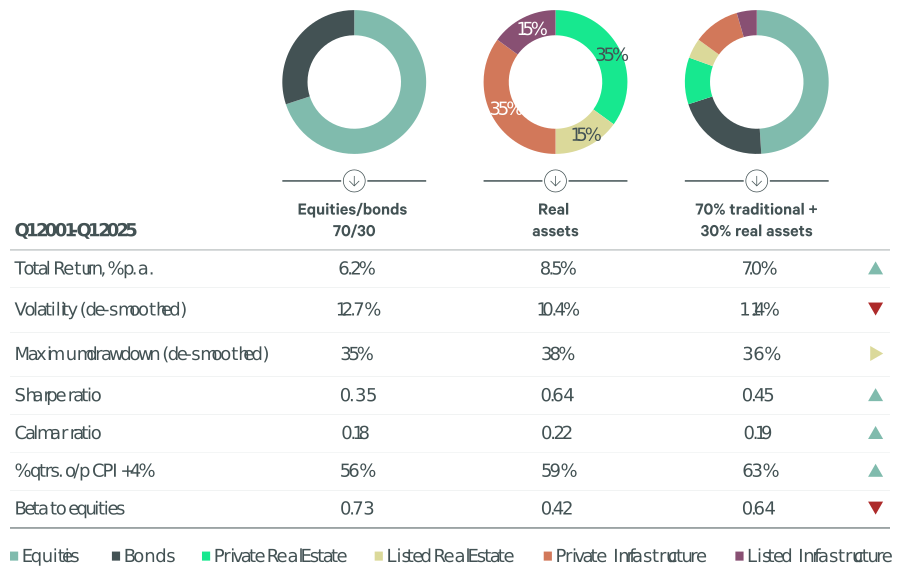
Sources: CBRE Investment Management, MSCI World Index (Equities), Barclays Global Aggregate Indices (bonds), FTSE EPRA/NAREIT Developed Index (listed real estate), MSCI Real Estate Indices de-smoothed (private real estate), 50/50 blend of EDHEC Global Index and Cambridge Associates US Infrastructure Index (private infrastructure), FTSE Global Infrastructure Core 50/50 Index (listed infrastructure).
Shallower drawdowns
Portfolios with 30% real assets not only experienced shallower losses but also demonstrated faster recovery in periods of market stress, demonstrating resilience. This effect was particularly evident during inflationary shocks, when equities and bonds tended to fall concurrently. A rolling drawdown analysis showed equivalent findings for portfolios.
Improved capital efficiency
Real assets stabilize outcomes without reliance on leverage. Portfolio decomposition shows that real assets contributed less to total risk than their capital weight would suggest, resulting in a more evenly distributed risk budget compared to traditional equity-heavy configurations.
Stronger alignment with inflationary conditions
Private infrastructure and listed infrastructure delivered annualized returns of 9.9% and 9.1%, respectively, with lower volatility than equities—reinforcing their role as inflation-resilient return sources.
Provides left tail-risk mitigation
Probabilistic simulations over a 10-year horizon (calibrated with historical total return distribution characteristics; mean, standard deviation, skew and kurtosis, Q1 2004-Q4 2024) showed that portfolios with a 30% real assets allocation achieved a +0.6 percentage point uplift in annualized returns—not by increasing risk, but by reducing downside exposure. When tested across 20,000 return paths, these portfolios reported a materially tighter return distribution with significantly less left-tail risk—lower probability and severity of extreme negative outcomes.
This occurrence was particularly evident at 5%, representing the most adverse scenarios. Simulations of a traditional 70/30 equities-bonds portfolio produced a 10-year time-weighted return (TWRR) of –1.4%, compared to just –0.2% for the real assets-anchored portfolio. While average returns for portfolios inclusive of real assets only rose modestly, they benefited from reduced loss severity and more stable recovery trajectories, giving investors greater confidence in long-term capital preservation.
Figure 3: Adding real assets reduces tail risk and increases return consistency

For illustrative purposes only. Past performance is not necessarily indicative of future results. Based on quarterly total return data in USD. Private market returns are de-smoothed and adjusted for standard management fees as required. Calculated as compound annual rates. Without real assets, the allocation is 70% equities and 30% fixed income. With real assets, the allocation is 50% equities, 20% fixed income and 30% real assets.
Constructing a conceptual 25% real assets allocation
Once the decision is made to increase structural exposure to real assets, the focus turns to optimal allocations. CBRE IM’s modeling provides a conceptual framework—anchored in five complementary components in a practical 25% real assets allocation—each selected for their distinctive risk, return and resilience characteristics. This is not a prescriptive formula, but a starting point for investors looking to create a strategic portfolio that combines stable income, inflation resilience and genuine diversification across uncertain market conditions.
- Private Real Estate: ~8.0%
The first portfolio co-anchor provides long-term income, inflation alignment and defensive capital characteristics. These will consist of core, income-generating assets with durable cashflows and modest volatility. - Private Infrastructure: ~8.0%
The second equal portfolio co-anchor adds income durability via regulated or contracted cashflows, often with strong inflation pass-through mechanisms. These assets behave more like bond proxies with real return potential. - Listed Real Estate (REITs): ~3.5%
The second-tier allocations provide liquidity and cyclical upside. REITs are more volatile than private real estate but also respond quickly to growth expectations that can amplify returns during favorable market conditions. - Listed Infrastructure: ~3.5%
The liquid counterpart to core infrastructure holdings that offers the flexibility of publicly traded equities. Listed infrastructure delivers income and growth driven by essential services with the advantages and volatility of real-time market pricing. - Real Assets Credit: ~2.0%The final allocation enhances downside protection through senior secured debt backed by physical assets. Real assets credit provides income diversification and a differentiated return stream with low correlation to equity volatility.
Figure 4: Evolving real assets mix across portfolio configurations
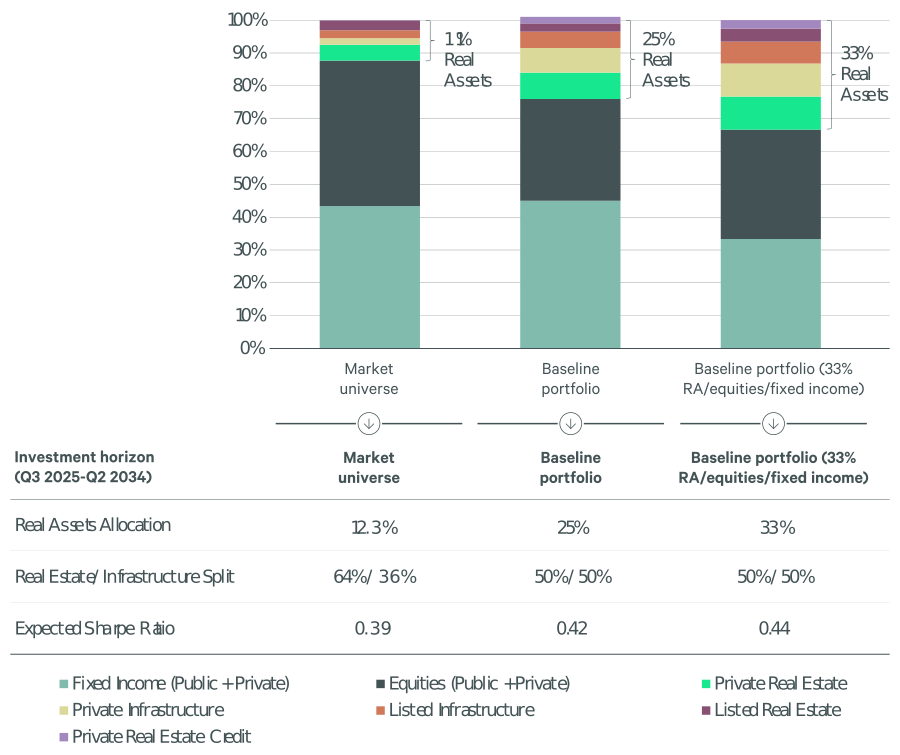
Corporate bond: Global Aggregate—Corporate.
Government bond: Bloomberg Global Government High Yield Bond: Bloomberg Global Aggregate. Credit – Corporate – High Yield.
Listed real estate: EPRA/NAREIT Developed REIT Index.
Unlisted real estate: MSCI Global Property Fund Index, de-smoothed by CBRE IM.
Unlisted infrastructure: Blend of Cambridge Associates Global Infrastructure Index and EDHEC infra 300 index, equal weighted, netted by CBRE IM.
Listed infrastructure: FTSE 50/50 Core Infrastructure index.
Real estate credit: Giliberto Levy L-2 index, custom selection by CBRE IM.
Private credit: Cliffwater Direct Lending index.
Real estate credit returns are only available as of Q1 2014. Returns in USD as of Q3 2024.
For illustrative purposes only. There can be no assurance any targets or business initiatives will occur as expected. Forecasts are inherently uncertain and subject to change.
The path to a reconstructed diversified portfolio
Once the target allocation and mix of real assets are established, the next step is to develop a practical transition plan. For many institutional investors currently holding only 10%-12% in real assets, this involves planning a careful, gradual increase toward 25% that aligns with existing liquidity needs, governance structures and capital planning processes.
The path does not require radical portfolio upheaval. A phased approach anchored in existing capital planning processes can deliver meaningful progress over time. For many institutions, a five-percentage-point increase every five years—via natural investment turnover as legacy positions mature, portfolio rebalancing, and new commitments—would be sufficient to reach the 22%-25% range within a decade. The Maple 8 funds provide a tangible reference point that forward-thinking investors have already achieved with ~25% real assets allocations through deliberate, multi-cycle repositioning.
For the vast majority of investors who are starting from 10%-12%, the transition requires reconfiguring the existing real assets mix as well as expanding the overall allocation. Diversifying beyond traditional real estate into infrastructure, listed strategies and real assets credit enables a more resilient, inflation-aware and cycle-responsive allocation—achieved within real-world liquidity and governance constraints.
Real assets should no longer be treated as tactical or opportunistic. Embedding them into strategic benchmarks and treating them as foundational exposures allows investors to better align portfolios with the structural realities of the coming decades—rising volatility, inflation uncertainty and fractured geopolitical norms.