Market Research
Paris Olympics: a vos marques, prêts, partez!
By: Alex Lund, CFA
June 14, 2024 5 Minute Read Time

Olympic tourism: more a marathon than a sprint
The most immediate impact comes from the influx of athletes, workers and tourists. A total of 15 million spectators are expected to visit Paris over the course of the games, of which around 3 million are international. Ironically for the city’s hotel industry, with 80% of visitors being locals or French day trippers, hosting the Olympics does not necessarily boost occupancy to the extent many would anticipate. Paris’ tourism board expects occupancy rates to fluctuate between 60% to 70% during the Games, down from 90% in July 2023. Increased competition from Airbnb is partly to blame, but the shortfall is largely caused by a reduction in “typical summer” tourists. Analysis of London 2012 showed a similar trend, with total visitor numbers down 5% during the month of August.
While fewer international tourists are expected overall, those that come do so with increased spending power, often twice that of typical tourists—Paris 2024 is expected to bring in an extra €4 billion in tourism spend as a result. Hosting the games also creates a more lasting tourism impact. While harder to directly quantify, with the Olympics streamed around the world to four billion TV viewers, a successful event can add significant curb appeal to the city’s image, boosting revenues in the hotel, retail and leisure sectors for years to come.
Setting the bar high for carbon neutrality
The Olympics has for decades come under scrutiny for its carbon impact on the local economy. Emissions are generally categorized into three major groups—construction, operations and spectators. The first and last of these groups often dominate the emissions footprint, as new stadiums are built, and athletes and spectators need to travel, often by air. While carbon offsetting is frequently used to lower net emissions, recent Olympic events have made substantial improvements to reduce both direct and indirect emissions. The IOC aligned with the Paris Agreement on Climate Change in 2021 and pledged to reduce emissions by 50% by 2030.
Figure 1: Carbon footprint of the Summer Olympic Games (Kt CO2)
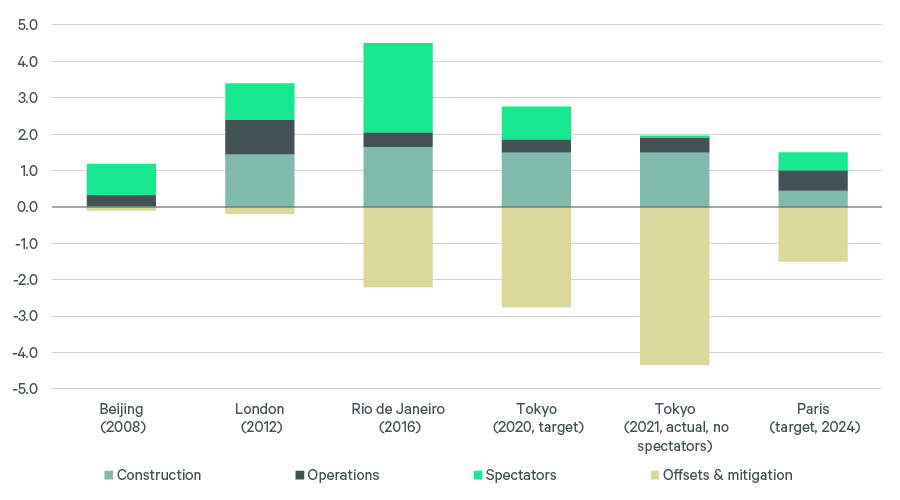
Paris’ carbon footprint goal to reduce emissions for the 2024 Games is ambitious. They aim to cut emissions by half compared to previous Games and bring CO2 down to 1.5 million tons or less. This would beat Tokyo’s Olympics in 2021, where no spectators were allowed due to COVID-19 restrictions. A major part of Paris’ carbon strategy is utilizing 95% of existing or temporary building infrastructure. No new stadium has been built to host the main athletics event, instead relying on the existing Stade du France. Other initiatives to decrease emissions include powering all sports venues with renewable electricity sources, rather than relying on fossil fuel generators.
Legacy housing plan—try not to fall at the first hurdle
The social impact of the Olympics is often equally judged. Previous events have been criticized for demolishing housing and existing infrastructure, often in deprived areas, to make way for olympic venues. The existing neighbourhood of Saint Denis is not a like-for-like comparison with London’s 2012 Stratford site, but shares many similarities in terms of demographics. Both were former industrialized areas, comprising some of the poorest districts in the city, both have above-average unemployment rates and social housing tenants.
London originally pledged to build 30,000 to 40,000 new homes as part of the wider Olympic site, with half offered as affordable. Over a decade later, only a third of the target housing has been built, with only a third designated as affordable. Social housing completions have been particularly limited, at odds with Newham having one of the highest social housing waiting lists in the country. You need only look at the change in household incomes on the Olympic site to understand the shift in earners that’s taken place.
Figure 2: Net household income by area (local currency, 000s)

Paris 2024 plans to change this Olympic legacy. Its use of 95% of existing infrastructure means fewer demolitions are needed to make way for new sports venues. Within a year of the event, the new Olympic village will be transformed into 2,800 new housing units for local residents, split equally between social housing, affordable middle-income rentals and private sales. New schools, student accomodation, and green park space will also be incorporated on site. While it remains to be seen exactly how this area will evolve, the aim is to ensure inclusivity from the start.
Saint Denis office rents to shift gears?
Although not directly linked to the Olympics, Saint-Denis is set to undergo a major transformation with the opening of the Grand Paris Express—the largest transport infrastructure project in Europe. The area will benefit from the largest new metro station, forming an intersection between four new metro lines, with 250,000 passengers expected to pass through daily. One of the four lines is on track to open in June 2024, with the remainder following between 2026 and 2030.
Figure 3: Delta in prime office rents (local currency psqm)

Similar to Stratford pre 2012, office rents in Saint-Denis have consistently lagged neighboring submarkets, with the delta versus the Western Crescent averaging just over €200 psm per annum for the last two decades. Plans for the wider station area’s future regeneration are still uncertain, with the onset of hybrid working likely to see fewer offices in favor of more residential. As with Startford in the late 2010s, the injection of new office supply and arrival of new transportation infrastructure could see a seismic shift in rents, with Saint-Denis offering a competitive and highly-connected alternative to its neighbors.
Final thoughts
Hosting the Olympics is a highly coveted trophy for many cities, but it also comes with huge responsibility. 2024 is set to be the first Games in the modern era where sustainability is at the forefront of planning. The Paris organizers have rightly thrown down the gauntlet in terms of carbon neutrality, housing, and infrastructure targets. Only time will tell if these plans pay off and the Paris Olympics leaves a lasting legacy that sets the bar high for future Games. We will be cheering on from the crowd.