Market Research
Manufactured Housing: A Market Response to U.S. Housing Affordability
November 12, 2026 10 Minute Read Time
Executive summary and key calls
Author
Director, Regional Research

The overall scale of the U.S. housing shortage is debatable but the dearth of affordable housing is self evident. The bipartisan 21st Century ROAD to Housing Act, which became law in July 2026 and is effective January 2027, explicitly aims to boost manufactured housing (MH) as the only available unsubsidized solution to deliver new affordable housing at scale.
But the MH sector is complex. Investors must consider various nuances to project how the ROAD Act will impact the expansion of MH, as well as where and how institutional capital can contribute positively. This paper discusses the current state of MH and the investment opportunity, with the following key takeaways:
Key call 1: The U.S. has a massive affordable housing shortage; MH is the only scalable, unsubsidized solution to expand the affordable housing supply.
Key call 2: The ROAD Act will grow MH demand faster than lot supply can keep pace.
Key call 3: Institutional capital can play a constructive role in growing, densifying and improving MH communities to meet demand.
The most affordable market-rate housing segment can help to alleviate the affordable housing shortage
The U.S. does not have enough affordable homes
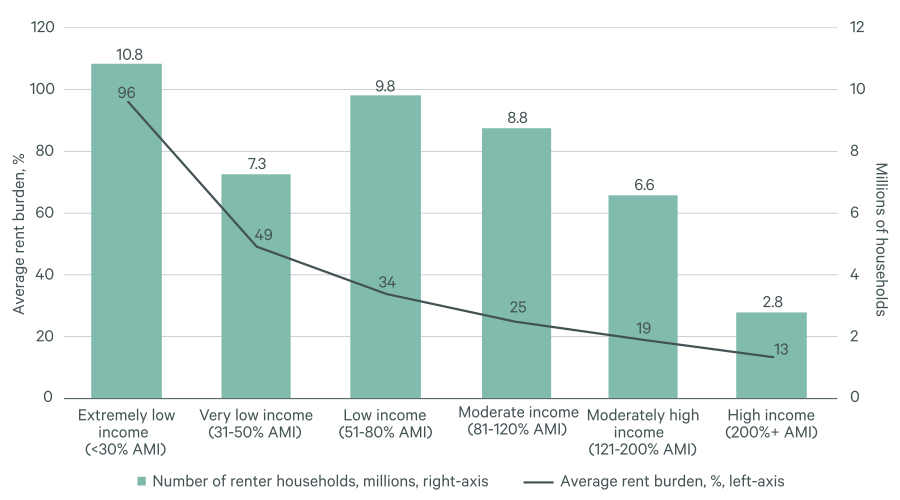
Whether the U.S. has an overall housing shortage is subject to more debate than commonly acknowledged. If household formation remains depressed and does not return to the rates of previous decades, the aggregate shortage is likely minimal, notwithstanding local imbalances. However, when considering whether would-be households can find homes that they can afford, the data is clear: the U.S. has an acute affordable housing shortage. In this article, we use the term “affordable housing” to describe housing that allows households, particularly in lower-income brackets, to spend less than 30% of their total income on rent; this is distinct from purpose-built, regulated and subsidized low-income housing. Figure 1 shows that roughly 17 million lower-income households (more than 20 million overall) spend more than 30% of their income on rent, which is commonly considered cost burdened.
Figure 1: Renter households by income bracket, millions, and rent burden, %
Manufactured housing is the most affordable market-rate housing solution
Manufactured housing, defined as a home built off-site to federal Housing and Urban Development (HUD) code, is the most cost-effective and practical way to increase the supply of affordable housing without requiring heavy subsidization and/or lengthy and expensive grant processes. According to research from the Joint Center for Housing Studies of Harvard University, the total cost to build a typical multi-section unit manufactured home, such as a CrossMod, is, on average, less than 75% of the cost to build a comparable site-built house.1 The costs decrease significantly for smaller single-section units, which can be built for roughly 35% of the cost of a comparable site-built unit (Figure 2). Moreover, these costs should drop further with the recent legislation removing the permanent chassis requirement, as described in the next section. From a cost perspective, MH presents a key solution to increasing the supply of affordable housing and relieving the cost burden for more households.
Figure 2: National construction cost estimates, as of 2020, $ thousands
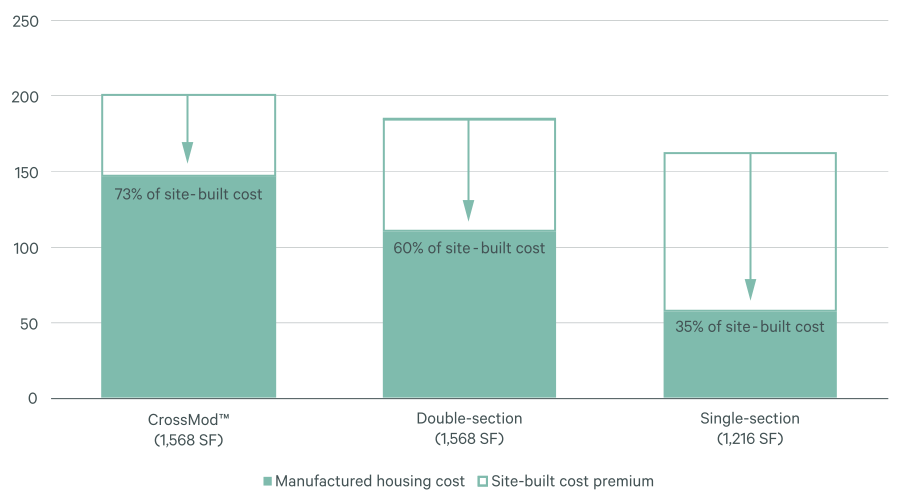
Notes: Foundation costs for manufactured homes include site prep and footings. Transportation and installation costs include transportation, siting of home, skirting, trimming out home, on-site add-ons, and cleaning. CrossMod™ also includes costs of raising roof and adding a garage. The site-built house for comparison with CrossMod™ includes a single-car garage, which is not included with double-section or single-section comparisons.
Source: Chris Herbert, Chad Reed, Dan McCue, Alex Hermann and James Shen, “The Potential and Challenges of Using Manufactured Housing to Expand Entry-Level Homeownership,” Joint Center for Housing Studies of Harvard University, 2/16/2024.
Authors’ tabulations of RS Means data for site-built homes and Next Step industry survey for manufactured homes. Cost of garage addition is from RS Means for both housing types.
The 21st Century ROAD to Housing Act supports MH demand, with an important distinction
In July 2026, the bipartisan 21st Century ROAD to Housing Act became law and could give MH its biggest demand boost in decades. The legislation contains several impactful provisions around physical and financial aspects of MH that should help to level the playing field with conventional housing. As a result, MH should become cheaper to produce and more affordable. But there is a catch: most of the benefits, especially related to financing, accrue to MH households who own their home and lot. Meanwhile, local jurisdictions remain responsible for increasing the number of available lots.
One key provision removes the requirement that manufactured homes be built on a permanent chassis, the steel frame integrated into the home's floor system that allows it to be fitted with wheels and axles and towed to its site. The change recognizes that most manufactured homes are not really meant to be mobile: they are typically transported once, from the factory to their site, and rarely moved again, since relocation is costly and many homes are placed on permanent foundations.
The change allows best practices in modular construction to be applied at greater scale. Without the chassis requirement, manufacturers can use modular-style techniques, such as setting homes on foundations by crane and building more varied or even multi-story designs, while still building to the HUD Code. Because the HUD Code is a single national standard that preempts local building codes, factories can produce these homes for markets across the country without adapting each design to different state and local codes. The result could be lower costs alongside improved design and quality. States are incentivized to certify equal treatment of homes with and without a chassis or will lose the right for chassis-less homes to be built, placed or sold within the state, costing potential jobs and affordable housing options to accommodate growth.
In another key provision, the Act formally authorizes HUD's Preservation and Reinvestment Initiative for Community Enhancement (PRICE), a competitive grant program that funds infrastructure repairs, home rehabilitation and replacement, and other investments to preserve manufactured housing communities, giving the program stable statutory footing after years of ad hoc appropriations. While appropriations do not guarantee funding, the Act puts PRICE on much more stable footing to continue to provide federal dollars for community improvement.
The financing provisions in the law, which raise Federal Housing Authority (FHA) Title I loan limits for manufactured homes and lengthen their loan terms, require HUD to develop a methodology for updating those limits over time, and authorize a pilot program to expand access to small-dollar FHA mortgages, should make manufactured housing meaningfully more affordable for potential buyers. Generally, MH has been financed using chattel loans, which are similar to personal property loans, rather than traditional mortgages, and therefore carry higher interest rates with fewer protections. Where the land and home are owned, the new law qualifies MH as real property, eligible for a traditional mortgage.
Finally, the ROAD Act calls for aligning construction standards nationally under the authority of HUD, lowering costs, shortening build times and improving supply chains while limiting regulatory creep and precluding conflicting rules across jurisdictions. The law also introduces incentives for local governments to allow more housing, including competitive Innovation Fund grants for communities that increase housing supply and, through the Build Now Act, federal funding tied to local housing production. It also directs HUD to develop a national set of model zoning frameworks, which advocates hope will encourage communities to allow manufactured homes wherever single-family homes are permitted and help overcome longstanding local prejudice against them.
The bill offers carrots to local municipalities to make MH placement easier but no sticks and does not guarantee that the supply of lots eligible for home placement will keep pace with the increased demand. In fact, the authors of the bill explicitly crafted the legislation to not override local jurisdiction on those decisions. Overall, there is a clear throughline to net new demand, but far more uncertainty how lot availability will respond, which remains largely in the hands of state and local authorities.
Industry nuance is critical to understanding the opportunity
Types of MH ownership
The MH sector includes several distinct types of ownership structures and physical footprints, all of which have investment implications.
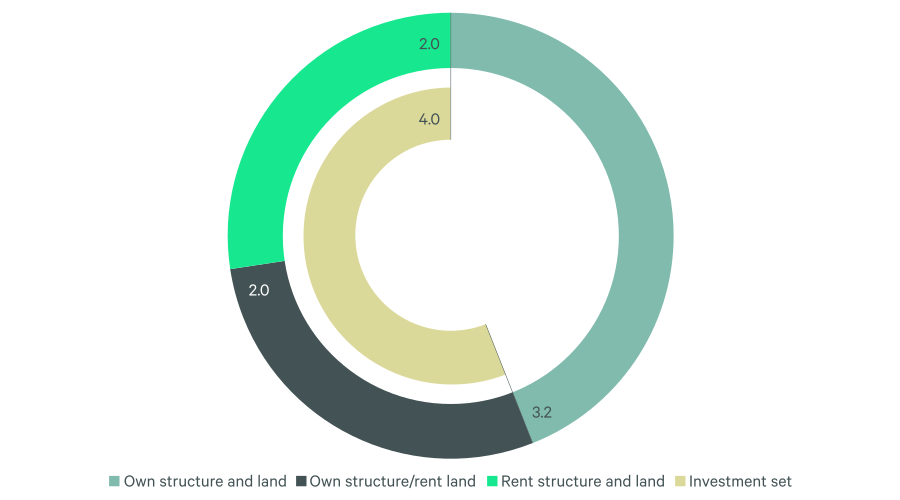
The roughly seven million existing MH households fall into three broad ownership/rental catagories: individuals own the structure and the land, individuals own the structure and rent the land, or individuals rent both the structure and the land. Owning both the home and the land is the most cost effective option for households and roughly 45% of MH residents are in this category, based on the most recently available data as of 2023; the remaining 55% are split roughly evenly between the other two categories (Figure 3). Of the 55% where the land is leased, institutional investors and public REITs own roughly one-third of the sites.
Figure 3: U.S. manufactured housing households, millions
Types of MH physical footprints
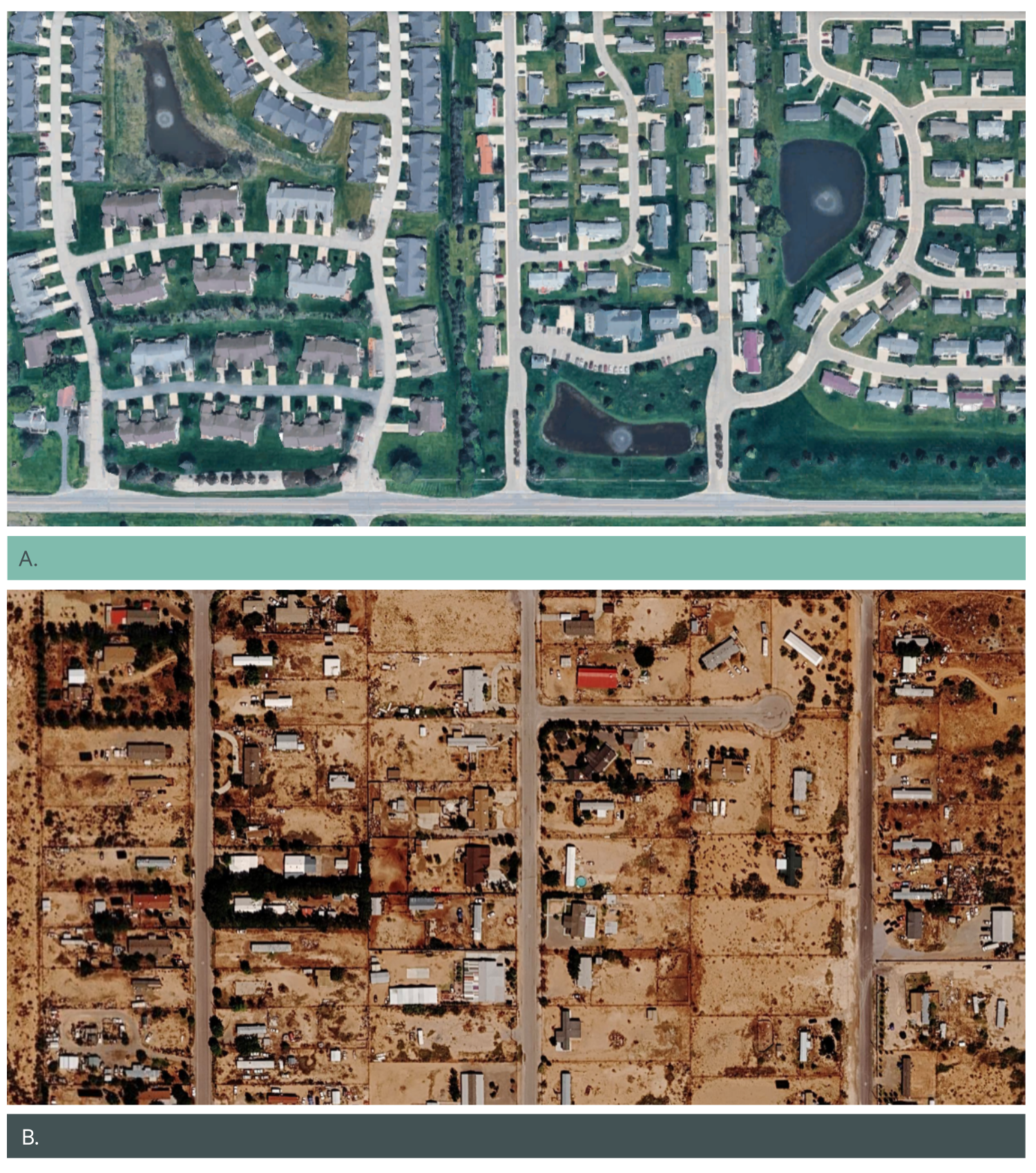
In addition to different ownership structures, MH units are generally clustered in two main types of physical locations, which can often be correlated with the ownership structure: designated manufactured housing parks (MHP) or informal subdivisions (IS). MHPs are most correlated with communities where the land is rented whereas IS is most common where the land and structure are owned. Examples are shown in Figure 4 (A represents MHPs and B represents IS).
Contributing to lower average costs for those that own the land and home, many IS communities are rural and lack basic infrastructure, including paved roads, sidewalks, streetlights and sewers. Sometimes these developments do not even have direct access to water and electricity. Additionally, many IS are not regulated by zoning or building codes, and instead have minimal subdivision regulation.
MHPs, by contrast, offer better basic infrastructure. While still often exurban, they are much more likely than IS to be infill as well. MHPs, especially newer or improved ones, can provide curated community and higher-end shared amenities, such as swimming pools or walking paths.
Figure 4: Illustration of variety of MH physical footprints
About 30% of new MH has been placed in communities in recent years, as compared with 70% on an owned lot outside of communities.2 The lack of expansion of communities due to NIMBYISM and zoning biases has restricted the placement of MH and therefor the production. The ROAD Act, especially the financing reform, primarily targets the own/own model with little to promote new community development. While several state jurisdictions are moving towards allowing as-of-right placement of homes on owned lots that are already zoned for single family, little current legislation exists to address the primary constraint on increased adoption of MH: zoning new communities. Therefore, the Act directly increases MH demand without directly or materially increasing the availability of sites to place those homes.
Opportunities for investment: densifying and improving MH communities
The lots available for placement have constrained MH expansion
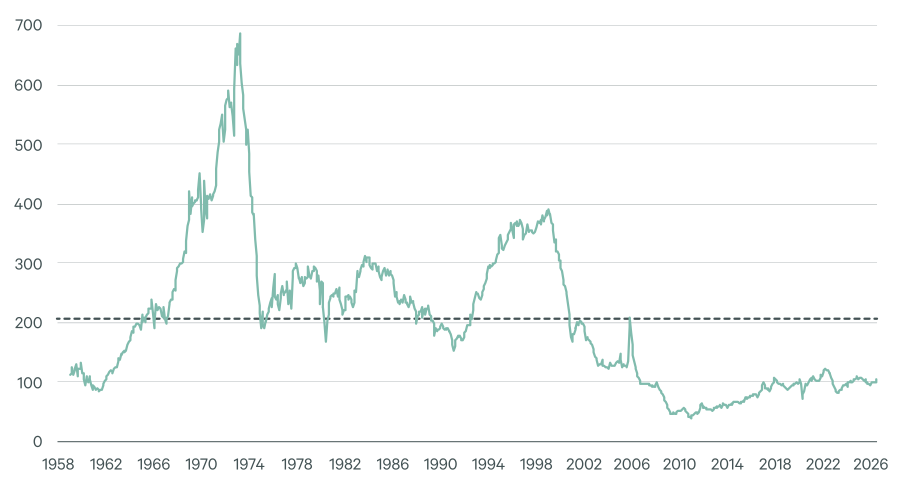
MH shipments peaked in the early 1970s and shipments have been significantly depressed since the global financial crisis (Figure 5). The lack of new sites to place new MH, especially in communities, has significantly impeded the potential to expand production and adoption. For example, nearly all residentially zoned land in the United States allows site-built homes by right, but nearly half of municipalities in Texas, the leading state by number of existing MH and shipments, do not explicitly allow MH on residentially zoned land or only allow MH by special permit or public hearing.3
Looking through another lens, roughly one-fifth of occupied MH, or approximately 1.4 million occupied homes, were manufactured prior to 1980, meaning they are at the end of their useful life. Total production of new homes has recently averaged about 100,000 homes per year. At that pace, it would take 14 years just to build enough homes to replace those that are entering obsolescene at 45+ years of age. Current production levels are not growing the housing stock; they are simply matching the replacement level needed to maintain existing lot placement. This situation once again highlights that the constraint is lot availability.
Figure 5: Mobile home shipments, SAAR, thousands
The supply and demand imbalance will persist
The ROAD Act directly incentivizes new home demand by lowering ownership costs, but has little to no direct mechanisms to address lot supply, contributing to an ongoing supply and demand imbalance.
Specifically, the Act aims to make MH cheaper and financing easier for those who own their lot while incentivizing, but not requiring, local municipalities to make placement easier. Demand should grow, but the availability of sites for MH placement will depend primarily on more localized legislation to increase zoning for MH and the ability of existing communities to increase density, including potentially through two-story homes. We do not expect the ROAD Act to meaningfully increase the number of new communities and the ability to increase the number of infill IS lots available depends on local jurisdictions.
Most MH placement in recent years has been in exurban or rural areas where basic infrastructure is scarce and the potential for a reasonable commute to work is low. In inner-ring suburbs, land values have historically been too expensive and zoning restrictions too prohibitive to make these more commutable own/own MH options affordable.
As evidenced previously, the degree of the supply and demand mismatch can be understood through the 17 million lower-income households that are spending more than 30% of income on rent while the industry produces only enough new homes to replace obsolescent homes. Rising occupancy and rents without a supply response points directly to supply barriers, not a lack of demand.
The opportunity for institutional capital is multifold:
-
MH communities with vacant lots offer the easiest path to increase the supply of commutable affordable housing, especially when the home can be placed on the site with a rent-to-own model. The rent-to-own model helps households that otherwise would not have the downpayment to own immediately and helps investors grow occupancy and revenue faster. While a win-win situation, it requires thoughtful execution to match an attainable price point with local community needs and the preference to own.
Communities with expansion site potential or the opportunity to aggregate adjacent land parcels to grow the community offer additional upside. This strategy balances in-place cash flows with partial development opportunity (see point 5).
Multi-story homes, made possible by the removal of the permanent chassis requirement, presents an additional strategy to serve more residents on existing sites.
-
Improving the physical infrastructure of existing communities offers a straightforward path to increase the value in many older MH communities and avoids zoning challenges. Adding or improving parks, roads, recreational amenities and walking paths that generally create more attractive communities creates measurable value for residents. The solidified PRICE grant program potentially offers another source of funding for these capex improvements. Historically, the grants have been awarded exclusively to non-profits, but the ROAD Act does not explicitly preclude for-profit investors from receiving grants. At a minimum there is opportunity for partnership between the for-profit and non-profit sectors to leverage these grants to maximum effect.
-
Institutions can provide deeper capital to bring new infrastructure to exurban and rural communities, especially where the municipal budget is nonexistent or insufficient.
-
MH offers an affordable alternative to traditional senior living, providing critical and much-needed community. Roughly one-third of MH parks are age restricted to 55+, reflecting the historical emphasis and importance of community. Numerous studies underscore the importance of social ties for aging populations, and MH can offer an affordable option at a time when traditional senior housing will be increasingly squeezed and rationed by income and availability.
-
Select opportunities to develop new communities exist where there is implicit and explicit backing by the local municipality. The major caveat is that this strategy requires incredibly patient capital. New communities often take up to seven to nine years or even more than a decade to stabilize, challenging financial feasibility and making conventional construction financing difficult to obtain. A patient investor could consider lending on new community development. The majority of investors should focus on acquiring and improving already stabilized communities, which will continue to face limited competition from new supply as discussed throughout this paper.
In short, we believe that:
- The U.S. has an affordable housing shortage of more than 20 million homes.
- The ROAD Act is a good step forward but will grow MH demand faster than supply in a sector that already faces a large supply and demand mismatch.
- The structural imbalance between supply and demand creates an attractive risk-adjusted investment opportunity centered around MH densification, as well as community improvement and development (where possible).
2 Manufactured Housing Communities in the U.S. - MHI
3 NZA Legislative Brief - Texas Senate Bill 785