Investment Perspectives
Infrastructure Holds the Center: Positioning in a Dynamic Market
August 29, 2025 7 Minute Read Time

Prefer a PDF?
Over the course of this year, listed infrastructure has been central to some of the most topical market dynamics: fast-changing expectations for the growth of generative AI, the relentless demand for electric power (particularly in the United States), the impacts of policy changes from the U.S. government and the outlook for global tariffs and potential changes in forward interest rates. When we consider the outlook, we believe listed infrastructure has the potential to sustain double-digit returns, which would eclipse the 8%-10% return it has provided over the last two decades. Below, we review:
- Notable news for infrastructure: generative AI, power demand and recent U.S. legislation
- The asset-class opportunity: considering tariffs, inflation, growth and changes in forward rates
- Our management of listed infrastructure for investors
A notable year for infrastructure:
Generative AI and power demand
At the beginning of first quarter earnings, news of the Deepseek AI model cast doubt upon the need for (1) increased data center capacity and (2) associated investments to service power demand. Stocks in the AI world, including those associated with powering AI, underperformed. The close of second quarter earnings brings a different view and those stocks are now higher, with the need for investment strengthened and the shortage of domestic power affirmed:
From the hyperscalers, major updates include:
- Company A: One major hyperscaler raised 2025 capital expenditures to $85B; 2026 expected higher and the majority to be spent on technical infrastructure.
- Company B: A second hyperscaler tightened 2025 capex guidance to $66-72B (up ~$30B from FY24) and indicating ~$100B of capital expenditures for 2026
- Company C: A third hyperscaler maintained 2025 capital expenditures of $88B with growth into 2026; Management stated: “We stood up more than 2GW of new capacity over the past 12 months alone. And we continue to scale our own data center capacity faster than any other competitor.”
- Company D: A fourth hyperscaler’s Q2 capital expenditures came in at $32B, implying an 83% YoY growth; Management noted that the company has more demand than capacity; the “single biggest constraint is power.”
We have seen positive signals in power markets themselves and on utility earnings calls. On July 22, PJM (the Pennsylvania-New Jersey-Maryland Interconnection), which serves as grid monitor for the largest unregulated power market in the northeast U.S. impacting 12 states, released results of its widely followed power market auction. Prices hit the cap in the auction, at a 20% premium to 2024 levels and 10x 2023 prices. On Q2 utility earnings calls, we’ve seen a few special “interim” budget upgrades, which are itself signs of upward momentum for the need for investment. One large utility increased its peak power load estimates by ~60% through 2030 and raised its five-year spending budget by ~30%. Management noted that “demand for power is growing at a pace not seen” over the course of their career.
How are we positioned to benefit from power demand? In our portfolio, ~30% of our holdings are exposed to the power demand theme in the U.S. We are confident in our view that our power-exposed utilities will see accelerating earnings growth not captured in consensus forecasts, and that our contracted power, data center and midstream energy holdings will continue to benefit investors.
One Big Beautiful Bill Act (OBBBA): Clarity for Infrastructure Development
For infrastructure investors, the passage of the wide-ranging budget reconciliation bill from the U.S. Congress brought clarity to a year-long uncertainty concerning the historic Inflation Reduction Act (IRA) and the fate of various tax credits. We’d note the following for investors:
- We believe the OBBB legislation is less disruptive than feared for renewable developers and a positive for owners of nuclear power. We remain positive on U.S. power markets with a preference for nuclear. In a sign of bi-partisan support, the OBBBA made no changes to the IRA rules for nuclear.
- The phase-out of tax credits for wind and solar provides the ability for developers to use tax credits up until 2029 under safe-harbor provisions. Tax credit phase-out post 2029 will enable higher repricing of Power-Purchase-Agreements over time.
- Regulated utilities with exposure to clean energy may benefit from the status quo of transferability, which can help their cash flows, while the visibility into the phase-out of credits reduces potential affordability shocks for consumers.
After the passage of the bill, with resulting clarity for renewable developers, we saw news that one of our holdings, AES Corporation, had received takeover interest from private infrastructure investors. AES operates both regulated utility and renewable development franchises, we had viewed shares as unduly pressured over the last year because of negative sentiment on renewables. We were excited to see this recognition in the market.
Tariffs, inflation, and forward rates— the impact for infrastructure
Over the summer, continued tariff uncertainty, the threat of higher inflation and signs of slower economic growth have dominated our discussions. We summarize key considerations below:


The building blocks of total return
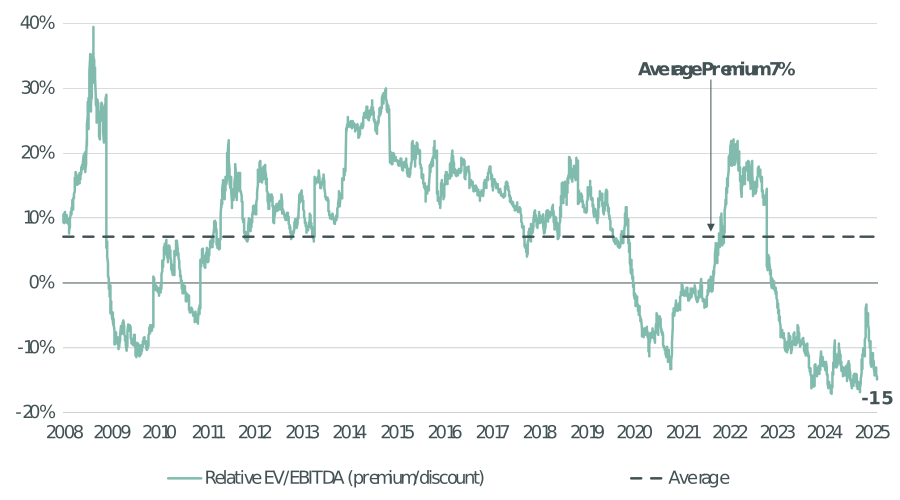
When we consider our outlook, we believe listed infrastructure has the potential to sustain double-digit returns for investors over the next five years. Listed infrastructure’s current trading multiple stands at a double-digit discount to equities compared to a historical premium. Valuations remain compelling relative to private markets. At the same time, earnings are accelerating above historical averages. The potential for inflation capture remains strong and infrastructure’s history of resilient earnings remains underappreciated. When taken together, we believe potential multiple expansion, a low- to mid-single-digit dividend yield and a high single digit earnings growth rate can enable the potential for double digit returns.
Infrastructure’s multiple is discounted to equities
Relative Earnings Multiple | Global Infrastructure vs Global Equities1
Earnings growth is above historical averages
Global infrastructure earnings2
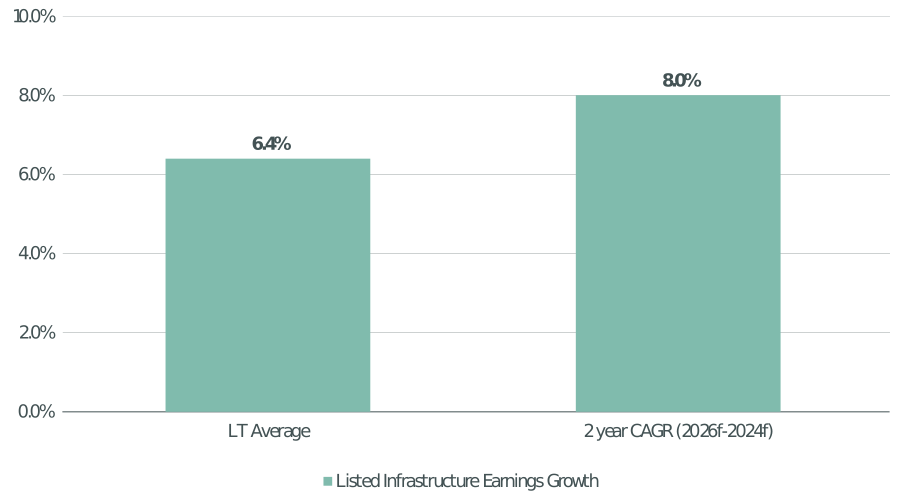
Source2: FTSE Global Core Infrastructure 50/50 Index as of 06/30/2025. “f” refers to “forecasts”. Estimates are derived with CBRE Investment Management and/or FactSet estimates for individual company estimates. EPS estimates can be affected by assumptions concerning revenue growth, operating margins, interest rates, and tax rate assumptions. . LT average represents a 20-year average. Information is the opinion of CBRE Investment Management, which is subject to change and is not intended to be a forecast of future events, a guarantee of future results, or investment advice. Forecasts and any factors discussed are not a guarantee of future results.
Our management of listed infrastructure for investors
In a dynamic environment, we continue to optimize our portfolios to build on our long-term track record.
With the recognition of a historic need for infrastructure companies to invest, we are mindful of which companies are well-positioned to manage their balance sheets, grow earnings and minimize the impacts to consumers.
In our portfolios, we manage for high conviction positioning with a degree of diversification and balance. We believe a diversified combination of infrastructure sectors and assets can potentially (1) lead to strong returns during periods of positive markets, while protecting during downside and (2) decrease the impact of tail risk events (wildfires, infrastructure failures, unanticipated regulatory developments) when they occur. As we look ahead to companies making new investments and growing their earnings for investors, we are excited by the opportunity to enhance returns from the listed infrastructure asset class.